
Gyan Management


Vikash Chaurasia1 and Kanupriya1
1Indian Institute of Foreign Trade (IIFT), Delhi, India

Creative Commons Non Commercial CC BY-NC: This article is distributed under the terms of the Creative Commons Attribution-NonCommercial 4.0 License (http://www.creativecommons.org/licenses/by-nc/4.0/) which permits non-Commercial use, reproduction and distribution of the work without further permission provided the original work is attributed.
This article seeks to assess the impact of the India–Japan Trade Agreement on the former’s micro, small and medium enterprises sector, by focusing on changes in the realms of employment, output and investment after the implementation of the said trade agreement, using the interrupted time series methodology. The main sources of data for trade are the ITC Trade Map, and for employment, output, and investment are the Annual Survey of Industries/Centre for Monitoring Indian Economy’s Economic Outlook databases. The major findings of this article could be summarised as follows. First, following the implementation of this trade agreement, the Indo-Japanese bilateral trade increased. However, the country’s trade balance remained in the negative territory, and the deficit widened after this agreement. Furthermore, this article finds the significant positive impact of this trade pact on sectoral output, employment and investment of the selected MSME sectors, namely chemicals, leather, article, textiles and handicrafts.
CEPA, India, Japan, MSME, trade
Background
The Indo-Japanese Comprehensive Economic Partnership Agreement (CEPA), signed in 2011, formalised the rich history of trade relations between the two nations. This is an extensive pact covering trade in goods, services and investment, and its main aim is to eliminate tariffs on more than 90% of tariff lines (with reference to bilateral trade over 10 years) (Kanupriya, 2025; Ministry of Commerce and Industry, Government of India, 2026).
It is because of the centrality of this trade agreement for India’s economy and the crucial role played by the country’s Micro, Small and Medium Enterprises (MSME) segment in its growth, output, employment and exports, that it is vital to assess its impact on the latter (Atri, 2025). Most literature in this context is missing the analysis of the impact of this trade agreement on the country’s MSME sector (Hattiambire & Harkal, 2022; Ministry of Commerce and Industry, Government of India, 2026; Mukherjee & Mukherjee, 2022; Press Information Bureau [PIB], 2024). While scholars such as Masanori may have discussed the implications of this trade pact for the Japanese small-scale industrial sector, no such studies exist for the Indian MSME sector (Masanori, 2012).
Examining how such agreements might help MSMEs overcome obstacles and boost their competitiveness in the global marketplace is made possible by the CEPA between Japan and India. As previously said, MSMEs play a crucial part in India’s economic structure, which is why it is important to investigate the economic effects of the India–Japan CEPA on them. It is crucial to determine which MSME sectors have benefited the most from this CEPA. Assessing how this CEPA affects MSMEs ensures that trade agreements’ benefits are shared equitably, fostering sustained economic growth and strengthening bilateral ties between India and Japan (Babu, 2012; Bhattacharyay & Mukhopadhyay, 2015; Gaurav & Bharti, 2019; Masanori, 2012).
In conclusion, this study aims to achieve three main goals. First, it looks at the patterns and trends of commerce between Japan and India before and after the India–Japan trade agreement was put into effect. Second, it aims to assess how this CEPA affects investment, employment and output in India’s MSME sector. Finally, it aims to provide policy recommendations to optimise the benefits of this CEPA for India’s MSMEs and provide tactics for future free trade agreements (FTAs) that can help the MSME sector in the nation.
The existing body of research on this topic is reviewed in the following section.
Present State of Art
Existing literature on India–Japan CEPA has various thematic strands. The first theme discusses the foundational concepts of India–Japan CEPA. The second deliberates on the effects of this trade pact on the Indian and Japanese economies. The third segment discusses the impact of the India–Japan CEPA on the MSME sector. In other words, this portion seeks to set the tone for this article by arriving at requisite research gaps and helping with the formulation of research objectives and hypotheses at later stages.
India–Japan CEPA: Some Basics
India and Japan signed their trade agreement (CEPA) in the year 2011. This agreement covers not just trade in goods but also in services and investments and focuses on tariff reduction/elimination on most goods, market access guarantees for services and relatively easier movement of professionals, stronger intellectual property (IP) rights protection and rationalised customs procedures and business environment (Kanupriya, 2025; Ministry of Commerce and Industry, Government of India, 2026). Structural impediments, including high services trade restrictiveness index (STRI) scores, non-tariff barriers and inadequate enforcement mechanisms, continue to constrain realised trade gains for the India–Japan CEPA (Maheshwari & Tiwari, 2026). The India–Japan CEPA has the potential to strengthen the two countries’ supply chain resilience and also create alternative supply chains. In the process, this would help raise employment and productivity profiles across the two countries (Kumar, 2025).
The next few paragraphs discuss the effects of India–Japan CEPA on the two countries’ economies. Both the positive and the negative impact would be discussed.
Effects of India–Japan CEPA on the Indian and Japanese Economies
Following the signing of trade agreements with countries like Japan and South Korea, India experienced a decline in the revealed comparative advantage (RCA) index values for its leading product export categories, particularly those related to Japan and South Korea (Banik & Kim, 2022; CNBC TV18, 2023; Nandi, 2023; Pandey & Unnikrishnan, 2023). Moreover, the FTA utilisation rate in the country remains low at 25%. This situation is attributed to a lack of awareness regarding the existing FTAs, as well as the complex rules of origin and trade documentation processes (Mishra, 2023). Additionally, India faces significant challenges due to fierce competition from other low-value-added manufacturers and exporters, highlighting the necessity to enhance its export profile through higher-value-added exports and improved logistics (Anand et al., 2015; Mishra, 2023). Mukhopadhyay and Bhattacharyay (2011) emphasise the need to strengthen physical and human infrastructure, coupled with structural reforms to fully tap into the benefits of India–Japan CEPA.
Japanese businesses are actively investing in local stock markets and are becoming more and more involved in the Indian economy. The Indian knowledge sector can benefit from its Japanese partner’s cutting-edge technologies, while Japan could benefit from India’s large market and skilled workforce. Despite strengthening economic ties, cultural exchanges have not yet reached their full potential (Narsapur & Bhardwaj, 2020; Sikri, 2009). Better resources are being provided to the Indian economy by Japanese investments, which is beneficial for productivity and growth (Narsapur & Bhardwaj, 2020). However, there is still potential for investments, especially foreign direct investment (FDI), to increase beyond the current levels (Chanda & Tokas, 2020).
Expected benefits of India–Japan CEPA have not materialised to the anticipated levels, even though bilateral trade between the two economies has increased (Babu, 2012; Kanupriya, 2025; Mathur & Doley, 2022). Trade and investment between India and Japan are hampered by issues of the likes of language hurdles, a lack of understanding of demand-supply dynamics and intricate business processes. Resolving these problems could encourage more trade and increase Japanese investments in India. Improving stakeholder comprehension of the CEPA and optimising its provisions for collaboration in particular industries must be the main goals of initiatives. To accomplish the goals of the CEPA, both countries must work proactively (Joseph & Bera, 2011; Nataraj & Ashwani, 2014; Siddiqui & Sharma, 2018).
Impact of India–Japan CEPA on the MSME Sector
Masanori (2012) contends that a number of Japanese MSMEs have entered the Indian markets ever since the trade pact between India and Japan was signed. The same led to an increased entry of Japanese MSMEs in the domains of food and agriculture and machinery. Not much work exists on the impact of this trade agreement on India’s MSME sector, except for some studies recommending that Japanese retail giants could aid the domestic small-scale industrial sector in reaching its true potential by enabling its integration with the global value chains (Prakash, 2025). As per Martinez (2024), trade agreements in general benefit participating economies by lowering tariffs, increasing exports, generating more business prospects, expanding manufacturing networks and increasing integration in regional and global supply chains by contributing to the availability of lower-priced intermediate inputs.
Based on the reviewed literature, the key research gaps could be summarised as follows. First, there exists a lack of research on the impact of the India–Japan trade accord on the domestic MSME sector. This is due to the relative lack of data availability and difficulties in categorising the relatively informal MSME sector. Second, accordingly, there is little to no analysis on the impact of the India–Japan trade agreement on output, employment and investment in the Indian MSME sector. This is also due to data and categorisation issues as enunciated earlier. Third, as the definition of the MSME sector changes with successive Acts (most notably, the MSME Act, 2006), it becomes difficult to quantify the impact on employment, number of units, output and exports generated through the sector, in a comparative frame (Bains & Arora, 2019).
Therefore, this study is an attempt to fill the said research gaps and thereby, meaningfully contribute to the existing body of literature.
The methodological approach used in this article is explained in the subsequent section.
Materials and Methods
The following research hypotheses are formulated based on the reviewed literature.
H1: Trade has risen following the enactment of the Indo-Japanese CEPA.
H2: India–Japan CEPA has enhanced production, job opportunities and investment within India’s MSME sector.
This study employs trade (exports and imports) data from the ITC Trade Map. Employment, gross value added (or output) and investment data are sourced from the Centre for Monitoring Indian Economy’s (CMIE’s) Economic Outlook database. The time period for the first hypothesis is from 2005 to 2024 (as the availability of data on the ITC Trade Map is from 2005 onwards). Time period for the second hypothesis is from 1973 to 2022, as per the feasibility of data availability and purpose of the investigation (to account for both pre-India–Japan CEPA and post-CEPA effects; as the said CEPA was signed in 2011) (CMIE data on the concerned variables were available since 1973 up to 2022 at the time of conducting this study).
Based on bilateral trade flows between India and Japan from 1973 to 2022, the interrupted time series (ITS) regression model is employed to assess the effect of the aforementioned CEPA on output, investment and jobs across India’s major MSME industries. The model offers a statistical tool for quickly and effectively evaluating the effects of a policy or intervention by looking at data gathered at different time periods before and after the intervention’s implementation. The functional form of the ITS model utilised in this study is summed up in the subsequent equation.
 (1)
(1)
where β0 is the intercept term, εt is the error term, β1 is the coefficient of the intervention dummy variable, and Xt is the intervention dummy variable, which has a value of 0 prior to and 1 following the intervention- here, implementation of the trade pact between India and Japan in 2011 (Rodrigues, 2020).
A number of indicators are then used to examine this data, such as export and import shares and trade balance, which is the difference between total exports and imports. Regarding the second hypothesis, an ITS regression model for the top five MSME sectors in India is estimated using the functional form stated in Equation (1) above.
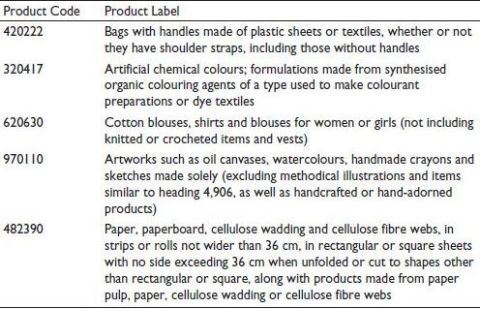
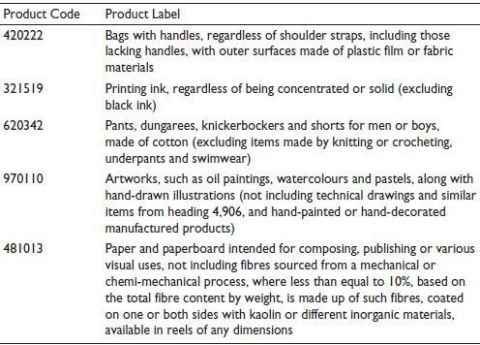
The top five MSME industries in India are chosen based on the most traded goods (both imports and exports) in order to investigate the effects of the India–Japan CEPA on employment, investment and output. The same are paper, textiles, leather, chemicals and handicraft sectors. The definition of the MSME sector in India is used to determine the top five MSME sectors in India (Table 1). The most traded product categories between Japan and India at the HS six-digit level are selected. This analysis only takes into account the most traded products (Ministry of MSME, Government of India, 2022-23). The corresponding HS codes for the same are 48 (for paper and its products), 42 (for leather products), 62 (for articles of apparel and clothing accessories), 32 (for paints, varnishes and inks) and 97 (for arts and collectibles/handicrafts). The following Table 1 and Table 2 represent the detailed HS six-digit codes for the MSME sectors being considered for this analysis.
Table 1. Five Leading MSME Products Exported to Japan by India as per HS 6 Digit Classification.
Source: Trade Map.
Table 2. Five Leading MSME Products Imported by India from Japan as per the HS Six-digit Classification.
Source: Trade Map.
The results and analysis of this article are presented in the following section.
Findings and Evaluations
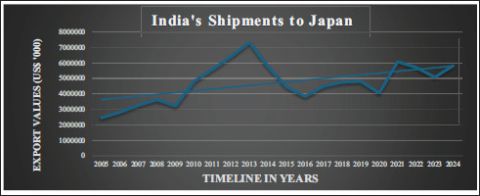
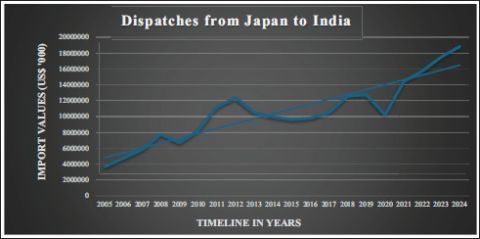
Figure 1,Figure 2, Figure 3 clearly depict India’s trade performance with respect to Japan by graphically plotting its export, import and trade balance values over the period 2005–2024.
Figure 1. India’s Shipments to Japan (2005–2024).
Source: Trade Map.
Figure 2. Dispatches from Japan to India (2005–2024).
Source: Trade Map.
Figure 3. India’s Trade Balance with Japan (2005–2024).

Source: Trade Map.
As illustrated in Figure 1, Indian shipments to Japan are experiencing a growth trend from 2005 to 2024. This is particularly evident in the period following the trade agreement in the year 2011. The same is also corroborated by the trend line.
Figure 2 shows that India’s imports from Japan have been increasing since 2005, with this trend becoming more noticeable following the signing of the India–Japan CEPA. Additionally, compared to India’s exports to Japan, the trend line for imports from Japan has a steeper incline.
Furthermore, as illustrated in Figure 3, the trade balance between India and Japan is progressively shifting unfavourably for India during the analysed period, particularly following the trade agreement between the two countries. This indicates that India’s imports from Japan significantly surpass its exports to that country. This trend may also suggest a decline in export competitiveness over time.
All in all, Figure 1, Figure 2, Figure 3 clearly show that India’s trade with Japan is increasing from 2005 to 2024. This can be seen in both the export and import statistics (in USD Thousand). The same pattern is evident in the post-CEPA timeframe, although somewhat unevenly. Regrettably, the trade balance (B.O.T.) is becoming more unfavourable for India, especially following the signing of the India–Japan CEPA in 2011. In addition, Figure 1,Figure 2, Figure 3 illustrate these trade indicators to aid in their visual examination. This is further supported by literature previously examined (Babu, 2012; Kanupriya, 2025; Mathur & Doley, 2022).
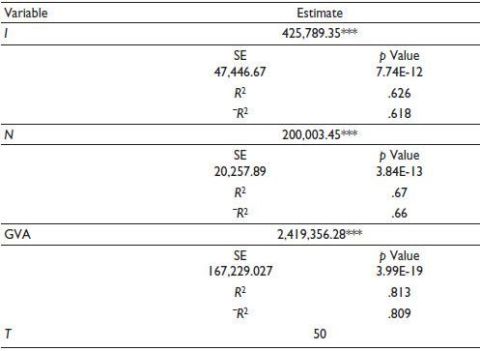
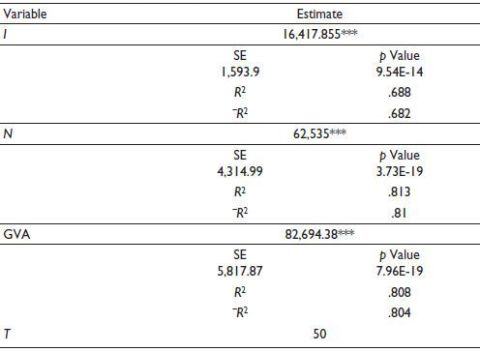
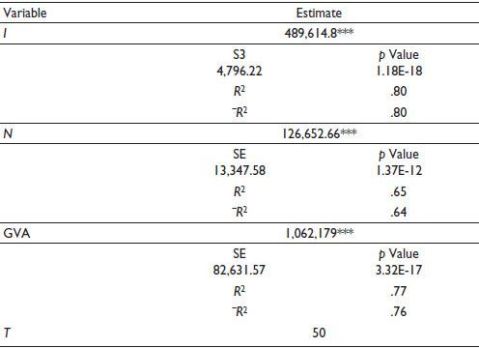
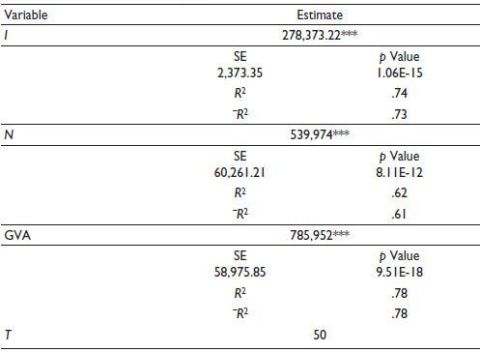
The subsequent tables summarise the impact on investments, employment and output across the chosen MSME sectors in the country, using the ITS model. For the purpose of interpretation in this segment, ‘I’ stands for Total Investments, ‘N’ stands for Total Employment, ‘GVA’ stands for Gross Value Added and ‘T’ stands for Total Number of Observations. In addition, R2 refers to R-squared, and ¯R2 refers to adjusted R-squared, respectively, throughout this section.
Chemical Sector
The dummy variable is designated a value of 0 to denote the years leading up to the implementation of the India–Japan CEPA, and a value of 1 from the year this policy was put into effect in 2011. Ceteris paribus, the outcomes in Table 3 provide persuasive evidence that the 2011 India–Japan CEPA had a significant and favourable effect on investment, employment and output in the chemical products segment of India’s MSME industry. The period of this analysis is from 1973 to 2022, as mentioned earlier as well. This is in line with the findings of Martinez (2024) and Prakash (2025) as discussed earlier.
Table 3. Effects of Indo-Japanese Trade Agreement on Investments, Jobs and Production in India’s Chemical Products Industry.
Note: ***Represents significance at 0.1 % level.
Leather Sector
Clearly, as depicted in Table 4, the India–Japan CEPA had a significant and favourable effect on investment, employment and output in the leather segment of India’s MSME industry. The time period of this analysis is also from 1973 to 2022. This is in line with the findings of Martinez (2024) and Prakash (2025) as discussed earlier.
Table 4. Effects of Indo-Japanese Trade Agreement on Investments, Jobs and Production in India’s Leather Industry.
Note: *** Represents significance at 0.1 % level.
Paper Sector
Clearly, as depicted in Table 5, the India–Japan CEPA had a significant and favourable effect on investment, employment and output in the paper sector of India’s MSME industry. The time period of this analysis is also from 1973 to 2022. This is in line with the findings of Martinez (2024) and Prakash (2025) as discussed earlier.
Table 5. Effects of Indo-Japanese Trade Agreement on Investments, Jobs and Production in India’s Paper Industry.
Note: *** Represents significance at 0.1 % level.
Textile Sector
Clearly, as depicted in Table 6, the India–Japan CEPA had a significant and favourable effect on investment, employment and output in the textile sector of India’s MSME industry. The time period of this analysis is also from 1973 to 2022. This is in line with the findings of Martinez (2024) and Prakash (2025) as discussed earlier.
Table 6. Effects of Indo-Japanese Trade Agreement on Investments, Jobs and Production in India’s Textile Industry.
Note: *** Represents significance at 0.1 % level.
Arts and Collectibles (Handicraft) Sector
As shown in Table 7, after the signing and implementation of the Indo-Japanese trade agreement, investments, employment and output are significantly and positively impacted in the handicrafts segment of the Indian MSME sector. The time period for this analysis is also from 1973 to 2022. This is in line with the findings of Martinez (2024) and Prakash (2025) as discussed earlier.
All in all, these results are not at all surprising as studies indicate a significant and positive impact on sectoral employment, output and investments due to FTAs (Mai & Bui, 2025; Ngo et al., 2025).
The next section concludes this study and lists its limitations, directions for future research and policy implications.
Table 7. Effects of Indo-Japanese Trade Agreement on Investments, Jobs and Production in India’s Arts and Collectibles (Handicraft) Industry
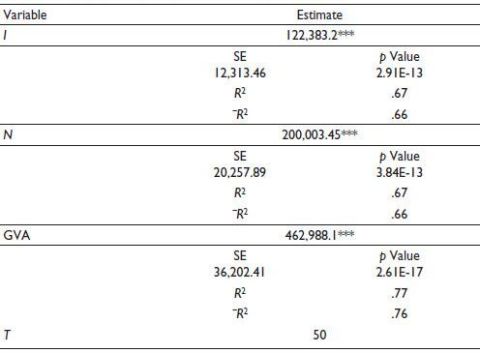
Note: ***Represents significance at 5% level.
Conclusion and Future Policy Implications
Commencing in 2011, the trade pact between Japan and India is aimed at fortifying economic relations between the two countries. This study shows that when the Indo-Japanese CEPA was put into effect, both imports and exports between India and Japan grew. India’s trade balance is negative, both before and after the adoption and implementation of this trade pact. After the India–Japan CEPA was implemented, this unfavourable balance worsened even more. The study sought to assess how this agreement affects India’s Micro, Small and Medium-Sized Enterprises (MSMEs), which are essential for a nation’s economy, particularly in sectors like chemicals, leather, textiles, paper and handicrafts, in terms of sectoral employment, output and investments. This 2011 policy adjustment had a positive and significant influence on investment, employment and gross value of output in each of the five investigated MSME industries. In this regard, this article is a novel attempt at assessing the impact of the said trade pact on the country’s MSME sector, for studies on this theme are nearly absent in a typical Indian context. As such, it shows the way forward to future researchers to explore the effects of India’s other trade pacts on its small-scale industrial sector—a vital segment in terms of contributions to India’s overall employment, output and exports.
In spite of all its merits, this study suffers from certain limitations. The same also serve as future directions for research. First, such studies could be extended to include an analysis of all trade agreements currently in operation, aside from the focus of this article, the India–Japan CEPA. Second, a pan-India primary survey, covering all four directions (North, South, East and West) could be conducted to understand the MSME exporters’ perspective after the implementation of this trade agreement in 2011. The assessment could range from analysing changes to the surveyed MSME sector’s exports, employment, value added and investments after the implementation of the India–Japan trade pact. Such extensions to existing research shall go a long way in expanding the scope and relevance of this otherwise pertinent article that seeks to study one of India’s prominent trade pacts in the context of its impact on the socio-economically important MSME sector. Third, there is no causal identification beyond ITS. A more comprehensive econometric technique could have been employed by future researchers on this topic. Fourth, firm-level data could be utilised by other scholars in the future and hence, build on this work that relies on aggregate sectoral data. Last, a comparative study could be undertaken to differentiate among MSMEs.
As far as the imminent implications of this study are concerned, future FTAs need to feature MSME-focused clauses that specifically acknowledge the distinct challenges faced by MSME businesses. Specialised mechanisms for dispute resolution of MSMEs, along with streamlined rules of origin and tailored schedules for tariff reductions, must be implemented through trade agreements. As many MSMEs are largely unaware of CEPA’s provisions, it is vital to make them cognizant of the same. Government agencies and trade associations should start specialised outreach programmes, conferences and online resources to educate MSMEs about the advantages of FTAs. This will offer simpler procedural instructions, real-time tariff and standard databases and tailored help in regional languages (Wang, 2024). In addition, for the chemicals exporters to Japan, the Government and associated export promotion councils must ensure strong compliance frameworks and focus on green and sustainable chemistry in order to meet Japan’s stringent chemical standards. For the leather, textile and handicrafts exporters, it is vital to focus on quality, scale and ESG compliance standards. For the paper exporters, it is imperative to understand the strict Japanese green procurement laws. Moreover, ecolabels could signal modern and environmentally sustainable manufacturing practices. This would help the sector gain a better foothold in the concerned market. In this regard, the role of relevant export promotion bodies/councils should not be ignored. The Government could actively rope in these bodies/councils to spread awareness about the product quality standards expected of any exporter in Japan across all the discussed MSME sectors (Import Export Federation, 2022).
Declaration of Conflicting Interests
The authors declare no potential conflicts of interest with respect to the research, authorship and/or publication of this article.
Funding
The authors received no financial support for the research, authorship and/or publication of this article.
ORCID iD
Kanupriya https://orcid.org/0000-0002-4186-4070
Anand, R., Kochhar, K., & Mishra, S. (2015). Make in India: Which exports can drive the next wave of growth? [IMF working paper]. Retrieved, 15 June 2026, from https://www.imf.org/external/pubs/ft/ wp/2015/wp15119.pdf
Atri, V. (2025). How India–ASEAN FTA (2010) and India–UAE Comprehensive Economic Partnership Agreement (2022) affect micro, small, and medium enterprises (MSMEs) in India. Retrieved, 15 June 2026, from https://papers.ssrn.com/sol3/papers.cfm?abstract_id=6319680
Babu, J. (2012). Indo-Japanese comprehensive economic partnership agreement (CEPA): A tool of strengthening bilateral trade relations. International Journal of Engineering Research and Development, 1(3), 23–32.
Bains, P., & Arora, S. (2019). Growth and performance of small scale industries in India: A comparative study of pre and post MSME Act 2006. IPE Journal of Management, 9(1), 14–25.
Banik, N., & Kim, M. (2022). India–Republic of Korea CEPA: Assessment and future path. Economies, 10(5). https://doi.org/10.3390/economies10050104
Bhattacharyay, B. N., & Mukhopadhyay, K. (2015). A comprehensive economic partnership between India and Japan: Impact, prospects and challenges. Journal of Asian Economics, 39, 94–107.
Chanda, R., & Tokas, K. (2020). India–Japan relations in services & the India–Japan Comprehensive Economic Partnership Agreement. IIM Bangalore. https://www.iimb.ac.in/sites/default/files/inline-files/ India_Japan_Relations_Services.pdf
CNBC TV18. (2023). Piyush Goyal calls for renegotiation of FTAs to protect India’s interests. Retrieved, 15 June 2026, from https://www.cnbctv18.com/economy/piyush-goyal-calls-for-renegotiation-of-ftas-to-protect-indias-interests-17358491.htm
Gaurav, K., & Bharti, N. (2019). Some common lessons from uncommon FTAs. South Asia Economic Journal, 20(1), 138–157. https://doi.org/10.1177/1391561418824479
Hattiambire, D. T., & Harkal, P. (2022). Challenges and future prospects for the Indian MSME sector: A literature review. Journal of Management & Entrepreneurship, 16(1), 13–21. https://xime.org/uploads/manuscripts/ Article%2021300157424.pdf
Import Export Federation. (2022). 8 huge problems faced by exporters in India & how to tackle them! Retrieved, 15 June 2026, from https://importexportfederation.com/problems-faced-by-exporters-in-india/
Joseph, M., & Bera, S. (2011). India-Japan trade and investment relations and their future prospects. Fore School of Management. https://mangaldaicollege.org/deptadminpanel/D_upload/study_U/India-JapanTrade%20and%20Investment%20Relations%20and%20their%20future%20Prospects%20(1).pdf
Kanupriya. (2025). Renegotiating India’s trade pacts: A study with reference to India’s Comprehensive Economic Partnership Agreements with Japan and South Korea. The Indian Economic Journal, 73(5), 911–916. https://doi.org/10.1177/00194662251332883
Kumar, N. (2025). Harnessing India–Japan economic partnership for supply chain resilience in the context of global trade policy uncertainties. India–ASEAN–Japan Cooperation for Diversified and Resilient Supply Chains, 62. https://isid.org.in/wp-content/uploads/2025/09/WP301.pdf
Maheshwari, A., & Tiwari, S. (2026). Services trade provisions in India’s free trade agreements: A scoping review of ECTA, CEPA, and bilateral CEPAs with Japan and South Korea. International Journal of Business and Management (IJBM), 5(1), 668–687.
Mai, H. G., & Bui, H. T. (2025). The impact of free trade agreements on foreign direct investment inflows: Evidence from next-generation agreements in Vietnam. Investment Management & Financial Innovations, 22(3), 1.
Martinez, S. (2024). A literature review on the effects of regional trade agreements (RTAs) on micro-, small- and medium-sized enterprises (MSMEs). Business and Public Administration Studies, 18(1), 13–19.
Masanori, K. (2012). Japan-India economic relationship: Trends and prospects. Research Institute of Economy, Trade and Industry. Retrieved, 15 June 2026, from https://www.rieti.go.jp/jp/publications/pdp/12p016.pdf
Mathur, V., & Doley, S. J. (2022). Trends and prospects of India’s trade with Japan: A study for the period 2002–2019. Shanlax International Journal of Management, 9(3), 1–10.
Ministry of Commerce and Industry, Government of India. (2026). India–Japan CEPA. Retrieved, 15 June 2026, from https://www.commerce.gov.in/international-trade/trade-agreements/india-japan-cepa/
Ministry of MSME, Government of India. (2022–23). MSME annual report 2022–23. Retrieved, 15 June 2026, from https://msme.gov.in/sites/default/files/MSMEANNUALREPORT2022-23ENGLISH.pdf
Mishra, R. D. (2023). UAE trade deal one of the most utilized. Retrieved, 15 June 2026, from https://www.livemint.com/economy/indias-free-trade-agreement-with-uae-expected-to-have-50-utilization-rate-says-government-official-11688317179178.html
Mukherjee, S., & Mukherjee, A. (2022). Indian SMEs in global value chains: Status, issues and way forward. Foreign Trade Review, 57(4), 473–496. https://doi.org/10.1177/00157325221092609
Mukhopadhyay, K., & Bhattacharyay, B. N. (2011). Economy wide impact of the trade integration between Japan and India: A GTAP analysis. In Nineteenth International Conference of IIOA, Washington, DC.
Nandi, S. (2023). India has asked Japan, South Korea to renegotiate FTAs: Piyush Goyal. Retrieved, 15 June 2026, from https://www.business-standard.com/economy/news/india-has-asked-japan-south-korea-to-renegotiate-ftas-piyush-goyal-123072701237_1.html
Narsapur, R. R., & Bhardwaj, A. (2020). India-Japan trade: A review. Retrieved, 15 June 2026, from https://papers.ssrn.com/sol3/papers.cfm?abstract_id=3603315
Nataraj, G., & Ashwani. (2014). India-Japan Economic Partnership Agreement: Gains and future prospects. Retrieved, 15 June 2026, from https://www.orfonline.org/public/uploads/posts/pdf/20230726123347.pdf
Ngo, Q. D., Nguyen, Q. H., & Toan, P. N. (2025). Assessing the impact of the European Union-Vietnam free trade agreement on labor market and employment in Vietnam. International Journal of Social Economics, 52(7), 1068–1083.
Pandey, D., & Unnikrishnan, M. (2023). Free trade agreements (FTAs) by India: Review and implications for future [IIM Ahmedabad working paper]. Retrieved, 15 June 2026, from https://www.iima.ac.in/sites/default/ files/2023-03/MCFME_FTAs.pdf
Prakash, A. (2025). ERIA-CII-ISID study on India–Japan economic partnership for resilient and diversified value chains. Retrieved, 15 June 2026, from https://eria-old.stagingserver.id/uploads/India-Japan-Economic- Partnership-for-Resilient-Diversified-Supply-Chains-rev2_.pdf
Press Information Bureau. (2024). The MSME revolution: Transforming India’s economic landscape. Retrieved, 15 June 2026, from https://www.pib.gov.in/PressReleasePage.aspx?PRID=2087361&utm®=3&lang=2
Rodrigues, J. (2020). Observational data analysis techniques. Retrieved, 15 June 2026, from https://www.informit.com/articles/article.aspx?p=3091772&seqNum=3
Siddiqui, A. A., & Sharma, N. (2018). Economic partnership between India and Japan—Comparative trade and sectoral analysis. International Journal of Business & Economics, 3(1), 42–65.
Sikri, R. (2009). India’s ‘look east’ policy. Asia-Pacific Review, 16(1), 131–145.
Trade Map. (2025). Retrieved, 15 June 2026, from https://www.trademap.org/Index.aspx
Wang, S. (2024). Fixing FTAs for MSMEs: Action points for better utilisation of trade agreements. Retrieved, 15 June 2026, from https://www.financialexpress.com/business/sme-fixing-ftas-for-msmes-action-points-for-better-utilisation-of-trade-agreements-3686928/
