Gyan Management


Kamalpreet Kaur1  and Navkiranjit Kaur Dhaliwal1
1Department of Commerce, Punjabi University, Patiala, Punjab, India

Creative Commons Non Commercial CC BY-NC: This article is distributed under the terms of the Creative Commons Attribution-NonCommercial 4.0 License (http://www.creativecommons.org/licenses/by-nc/4.0/) which permits non-Commercial use, reproduction and distribution of the work without further permission provided the original work is attributed.
The rapid growth of the Indian capital market has culminated in increased investor engagement, leading to a growing volume of investor complaints and creating major hurdles to regulatory control. This study investigates the efficiency of the Securities Exchange Board of India’s investor grievance redressal process, with a special emphasis on the SCORES portal in the post-financial crisis era. The objectives of the research are to assess the performance of the Securities and Exchange Board of India (SEBI) grievance redressal system and to identify trends in investor grievances received, settled, and pending from 2008–2009 to 2024–2025. A descriptive and analytical study design is used, with secondary data from SEBI’s annual reports and official publications. To evaluate long-term patterns, the analysis uses trend analysis and compound annual growth rate (CAGR) approaches. The findings of the study reveal an ongoing rise in investor complaints, reflecting increased market awareness and engagement. Cumulative grievance redressal rates regularly surpassed 95%, while pending grievances declined sharply due to improved efficiency and digital platforms such as SCORES and SCORES 2.0. However, the actual annual redressal rate remains moderate because of carried-forward grievances. The study concluded that SEBI’s grievance redressal process has significantly improved investor protection and market trust, highlighting the necessity of ongoing technology advancement and investor education to maintain regulatory efficacy.
Indian capital market, investors’ grievance redressal, investor protection, SCORES, SEBI
Introduction
Securities and Exchange Board of India (SEBI) SCORES is an autonomous forum for evaluating the effectiveness of the redressal system for investor complaints they encounter when interacting with stock market brokers and authorized companies (Ajit et al., 2017). Investors may occasionally file complaints against companies that are listed or any intermediaries that they deal with on the stock exchange. If they are dissatisfied, they can file an appeal with SEBI scores.
In an effort to streamline the complaint registration process, SEBI has given SCORES the authority to handle the redressal process more swiftly and effectively. A centralized database for all grievances and online visibility of the complaints’ progress and the actions made in response to them are SCORES’ most important features. Until 2011, the only way to handle grievances was offline, which consumed a lot of time and resulted in very few complaints compared to the real situation. Additionally, investors were unable to find out the outcome of their complaints, which caused them to become dissatisfied and mistrustful.
What Is SCORES
SEBI provides a digital grievance redressal tool called “SCORES.” Participants can file complaints about the securities market with SEBI-regulated firms such as listed corporations, authorized intermediaries, and regulatory institutions. Investors must first file their concerns with the entity involved, through its authorized individuals or officials who manage legal compliance and grievances of investors.
SCORES 2.0
SCORES was established in 2011 to support discontented investors whose complaints against listed businesses, registered intermediaries, or market infrastructure institutions have yet to be addressed. To improve the overall effectiveness of the grievance redressal procedure, SEBI introduced an improved version, SCORES 2.0 (SEBI, n.d.-a), with effect from April 1, 2024. This improvement shortened timescales, added automated routing of grievances to relevant institutions, and automatic escalation of accusations to SEBI for unsolved concerns. Furthermore, a two-level review mechanism has been established, making complaint resolution more effective.
Additionally, SEBI gets complaints via (CPGRAMS) Centralized Public Grievance Redress and Monitoring System of Department of Administrative Reforms and Public Grievances. These complaints can now be processed using SCORES 2.0 due to the integration of the CPGRAMS platform with SCORES 2.0
Characteristics of the SCORES 2.0 portal include:
Secure Portal and Market Intelligence Portal
On April 1, 2024, a web-based site called SECURE (SEBI, n.d.-b) was introduced to handle complaints regarding the freezing and unfreezing of accounts in accordance with orders from the Full Time Representatives of SEBI, judiciary and administrative bodies, or the expiration of debarment periods. Additionally, the Market Intelligence (MI) Portal (SEBI, n.d.-c) was created so that market players may provide information on market abuse, and it has been in use since May 2024. In 2024–2025, the MI portal received 356 inputs and notifications. Any related regulatory actions are posted on the SEBI website (Annual Report of SEBI 2024–2025).
Literature Review
The existing literature emphasizes the significance of regulatory frameworks and grievance redressal processes in protecting investors and preserving capital market confidence. Bose (2005) compared the Indian securities market’s regulatory framework to the US capital market, highlighting the significance of well-defined rules and regulatory powers in combating market misconduct and offering an equitable opportunity to investors. Taneja and Sharma (2005) examined retail investors’ understanding of grievance redressal procedures and investor education awareness programs, allowing investors to better defend themselves against fraudulent operations. Angela (2010) examined the procedure for resolving investor grievances in online trading using market facilitators, describing common investor complaints such as non-delivery of securities, settlement failures, and pricing disputes, and focusing on the importance of productive communication and timely enforcement by regulatory authorities. Pasha et al. (2012) examined SEBI’s role in overseeing capital market infractions and found that a stable capital market necessitates effective surveillance instead of undue interference by government. Venugopal et al. (2012) investigated the issues faced by small investors and discovered that various safeguards exist; a lack of understanding about suitable grievance mechanisms remained a key concern. Ravi and Bhoopal (2017) found consistent improvements in grievance resolution rates, reflecting SEBI’s established and specialized redressal mechanism. More recently, Vijayan and Prasad (2023) reported a significant decrease in unresolved issues and high investor contentment with the SCORES platform, which shows increased productivity, accessibility, and investors’ confidence in the capital market of India.
Objectives of the Study
Research Methodology
This study provides an analytical and descriptive analysis of the grievance redressal mechanism of SEBI’s SCORES for resolving investors’ grievances. The study used secondary data collected from annual reports of SEBI, that is, from 2008–2009 to 2024–2025, government publications, and other available sources about the actual redressal of investors’ grievances in the securities market of India and the data is analyzed using tables in MS Excel. Descriptive and statistical tools, such as compound annual growth rate (CAGR), trend analysis, line and bar charts, were used to interpret the study.
Status of Investors’ Grievances Received and Redressed by SEBI
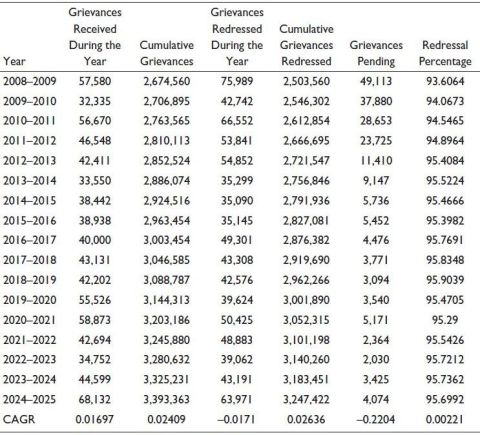
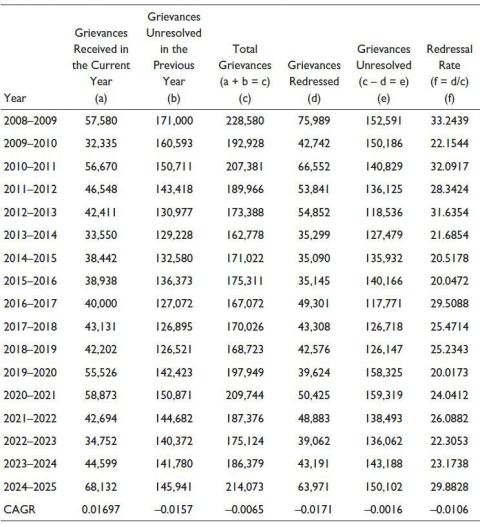
SEBI requires suppliers and facilitators to implement processes that handle investor complaints. SEBI directs grievances to the appropriate intermediary. Intermediaries must report their handling of grievances to SEBI within 30 days of receiving them. Table1 shows the trends in investor grievances received and redressed by SEBI throughout the years, and Table 2 shows the actual redressal rate of investors’ grievances from 2008 to 2025.
Interpretation and Analysis of Data
According to Table 1, the pattern of investor complaints that SEBI received between 2008–2009 and 2024–2025 shows a distinct long-term upward trend, which is indicative of rising investor awareness and market involvement. The trend is illustrated in Figure 1. Grievances first fell rapidly from 57,580 in 2008–2009 to 32,335 in 2009–2010, but they thereafter rose once again to 56,670 in 2010–2011, suggesting a resurgence of market activity. Between 2011–2012 (46,548) and 2013–2014 (33,550), a slow decrease was noticed, indicating better regulatory efficacy and compliance. After that, complaints grew slowly, reaching 43,131 in 2017–2018. During times of market volatility, they increased significantly, especially in 2019–2020 (55,526) and 2020–2021 (58,873). Despite temporary fluctuations in 2021–2022 and 2022–2023, complaints reached 68,132 in 2024–2025. In general, grievances resolved maintained up with inflows; SEBI resolved more complaints than it had in a number of years, including 2008–2009 and 2010–2011, which decreased the backlog. Institutional scalability was also demonstrated by high resolution levels in 2020–2021 (50,425) and 2024–2025 (63,971). The total number of grievances received grew from 26.75 to 33.93 lakh, while the total number of redressals increased from 25.04 to 32.47 lakh. Notably, the number of pending grievances dropped from 49,113 to 4,074, a decrease of more than 91%. The redressal rate peaked in 2018–2019 at 95.90%, continuously staying above 93% and above 95% in most years. The findings are further supported by CAGR analysis, which shows that pending grievances decreased by a noteworthy ?22.04%, cumulative redressal increased by 2.64%, and grievances received increased by 1.69%. Overall, the analysis shows that SEBI’s grievance redressal mechanism has been significantly strengthened, boosting investor trust and guaranteeing efficient protection in India’s capital market.
Table 1. Grievances Redressal Rate on a Cumulative Basis.
Source: Annual Reports of SEBI from 2008 to 2025.
Figure 1. Trend of Grievances Received and Redressed from 2008 to 2025.

Interpretation and Analysis of Actual Redressal Rate of Grievances
Table 2 shows the actual redressal performance of investor grievances from 2008–2009 to 2024–2025. The trend in the actual redressal rate is presented in Figure 2. The data reveal that the number of grievances received during the year fluctuated significantly, growing from 57,580 in 2008–2009 to 68,132 in 2024–2025, indicating increased investor participation and knowledge. The number of outstanding grievances from prior years remained significant; however, it showed a little decline over time, indicating a progressive clearance of backlog cases. The total number of grievances addressed each year has remained high, with a range of 162,778 to 214,073 cases.
Table 2. Actual Redressal Rate of Investor Grievances.
Source: Annual Reports of SEBI from 2008 to 2025.
Figure 2. Trend of Actual Redressal Rate of Grievance from 2008 to 2025.
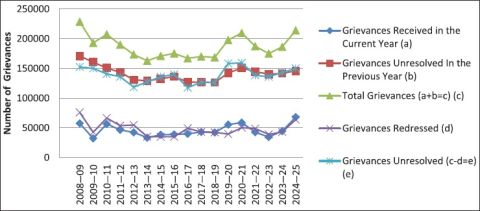
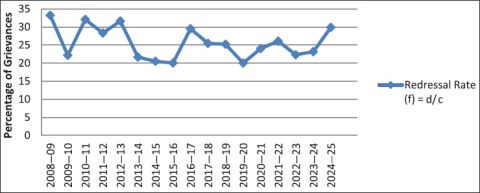
The overall number of complaints redressed annually varies, with greater resolution levels reported in years such as 2010–2011 (66,552), 2020–2021 (50,425), and 2024–2025 (63,971), illustrating SEBI’s ability to speed up redressal during periods of significant intake. Despite these efforts, a considerable number of grievances went unaddressed each year, emphasizing the ongoing burden of carried-forward cases. The actual redressal rate fluctuated between 20% and 33%, with a bit higher effectiveness recorded in 2008–2009, 2010–2011, and 2024–2025. The CAGR numbers show a positive growth in grievances received (1.69%) and a small improvement in the redressal rate (0.10%), while negative CAGR values for pending complaints indicate a slow but consistent drop in pendency. At the end, it shows that even though SEBI has improved its grievance redressal system over time, additional advancements are required to boost annual clearance efficiency and more consistently remove backlog cases.
Findings of the Study
Figure 3. Percentage of Grievances Redressal Rate from 2008 to 2025.
Conclusion
The SEBI has greatly improved investor protection by implementing an effective grievance redressal system. An analysis of complaint files from 2008–2009 to 2024–2025 reveals a consistent growth in investor awareness and participation. SEBI has reduced the number of ongoing cases while maintaining a cumulative redressal rate above 95%. Using technologically advanced systems such as SCORES and SCORES 2.0 has increased grievance management efficiency and transparency. Despite a moderate annual redressal rate due to pending litigation, SEBI’s initiatives have boosted investor confidence and contributed to the stability of the capital market of India.
Limitations of the Study
Declaration of Conflicting Interests
The authors declared no potential conflicts of interest with respect to the research, authorship and/or publication of this article.
Funding
The authors received no financial support for the research, authorship and/or publication of this article.
ORCID iD
Kamalpreet Kaur https://orcid.org/0009-0000-6519-8351
Ajit, D., Malik, S., & Nautiyal, S. (2017). Effectiveness of SEBI’s complaints redress system (SCORES) in India. IOSR Journal of Business and Management (IOSR-JBM), 1–72. https://www.sebi.gov.in/sebi_data/DRG_Study/DRG_II_Scores_15092015.pdf.
Angela. (2010). Investor grievance redressal mechanism. Retrieved, February 16, 2010, from http://articledashboard.com
Bose, S. (2005). Securities market regulations: Lessons from US and Indian experience. The ICRA Bulletin: Money & Finance, 2(20–21), 83–124. Available at SSRN: https://ssrn.com/abstract=1140107
Pasha, S., Krishna, R. V., & Gopikiran, H. V. (2012). A study on role of SEBI in Indian capital market: An empirical analysis. Zenith International Journal of Multidisciplinary Research, 2(3), 396–413.
Ravi, P., & Bhoopal, M. (2017). Investors’ grievances redressal mechanism in SEBI. International Journal of Engineering Technology Science and Research, 4(7), 721–725.
SEBI. (n.d.-a). SCORES: SEBI complaints redress system. Retrieved, 1 June 2026, from https://scores.sebi.gov.in/
SEBI. (n.d.-b). SEBI portal for complaints on unfreezing PAN in relation to enforcement actions (SECURE). Retrieved, 1 June 2026, from https://secure.sebi.gov.in
SEBI. (n.d.-c). SEBI market intelligence portal. Retrieved, 1 June 2026, from https://mi.sebi.gov.in
SEBI. (2011, June 3). Processing of investor complaints against listed companies in SEBI complaints redress system (SCORES) (Circular No. OIAE/2/2011). Retrieved, 1 June 2026, from https://www.sebi.gov.in
SEBI. (2024a). SEBISCORES [Mobile app]. App Store. Retrieved, 1 June 2026, from https://apps.apple.com/us/app/sebiscores/id6478849917
SEBI. (2024b). SEBISCORES [Mobile app]. Google Play. Retrieved, 1 June 2026, from https://play.google.com/store/apps/details?id=com.sebi
Taneja, P., Sharma. (2005). Capital market reforms: A case study of grievances and awareness of retail investors in the stock market. In B. Singh & J. Singh (Eds.), Securities market operation and reforms (pp. 20–30). Deep and Deep Publishers.
Venugopal, P., Sudarsan, K., & Himachalam, D. (2012). Small investors’ grievances and redressal mechanism in Indian capital market. Retrieved, 1 June 2026, from http://www.zenithresearch.org.in/images/stories/pdf/2012/JULY/ZIJMR/11_ZIJMR_JULY12_VOL2_ISSUE7l.pdf
Vijayan, P. V., & Prasad, R. R. (2023). Role of SEBI in investor grievance redressal. Management Researcher, 29, 223–227. https://www.imdrtvm.com/article/imdr-article-1692475846.pdf
Websites
SEBI. (2008). Annual Report 2007–2008.
SEBI. (2009). Annual Report 2008–2009.
SEBI. (2010). Annual Report 2009–2010.
SEBI. (2011). Annual Report 2010–2011.
SEBI. (2012). Annual Report 2011–2012.
SEBI. (2013). Annual Report 2012–2013.
SEBI. (2014). Annual Report 2013–2014.
SEBI. (2015). Annual Report 2014–2015.
SEBI. (2016). Annual Report 2015–2016.
SEBI. (2017). Annual Report 2016–2017.
SEBI. (2018). Annual Report 2017–2018.
SEBI. (2019). Annual Report 2018–2019.
SEBI. (2020). Annual Report 2020–2021.
SEBI. (2021). Annual Report 2021–2022.
SEBI. (2022). Annual Report 2022–2023.
SEBI. (2023). Annual Report 2023–2024.
SEBI. (2024). Annual Report 2024–2025.
