
Gyan Management


Charvy Narang1 
1Punjab Agricultural University, Ludhiana, Punjab, India

Creative Commons Non Commercial CC BY-NC: This article is distributed under the terms of the Creative Commons Attribution-NonCommercial 4.0 License (http://www.creativecommons.org/licenses/by-nc/4.0/) which permits non-Commercial use, reproduction and distribution of the work without further permission provided the original work is attributed.
Banking sector is the backbone of the Indian financial system. Banking plays a predominant role in financial inclusion in every economy. The Indian banking sector has undergone a drastic change over the years. Mobile banking is one such innovation that is changing the landscape of the Indian financial system. The study employed an extended UTAUT2 model to determine a comparative study of factors influencing behavioural intention towards adoption of mobile banking in rural and urban users. Significant structural differences between rural and urban respondents were found for structural relationships, namely attitude ? behavioural intention, habit ? user behaviour and trust ? behavioural intention.
Mobile, banking, UTAUT2, behavioural, intention
Introduction
Banking sector is an important pillar of the Indian financial system. It plays a significant role in achieving sustained and inclusive growth of an economy. It is the parameter of the financial health of an economy. In the present era, the world has evolved into a global village where everything is facilitated with the aid of advanced technology.The continuous advancements in the field of technology have changed the landscape in which people access banking services. The technology growth is happening at a very high pace, making the lives of people easier and more hassle-free.
Banks are continuously competing with the global environment and introducing new services with high convenience to their customers for their survival and revenue generation. Banking sector has outpaced all the other sectors in the adoption of internet technology.The Internet is a big network of various computers and computer networks that communicate with each other using the same communication protocol (Mittal, 2004). It was recognised long before that the internet was bringing revolution in retail banking, as stated by Business Week (Tan & Teo, 2000). An increase in internet subscribers led to the adoption of self-driven banking channels. Self-service technologies are automated delivery channels that allow customers to assess a service without any involvement of service employees (Bitner et al., 2002). Self-service banking technology includes ATMs, internet banking, telephone banking and mobile banking.
Mobile banking refers to providing banking services through a smart mobile device (Kadalarasane, 2015). It is acknowledged as the best-suited method to perform banking transactions in this technology-driven environment. Mobile banking is the delivery of financial services through mobile networks, which is performed on mobile phones (Alampay & Moshi, 2018). Mobile banking is anywhere, anytime banking (Kadalarasane, 2015). Various financial products can also be purchased through mobile banking, such as life insurance, health insurance, fire insurance, mutual funds and IPO. One can also instruct the bank to make payments for the payment of various bills through mobile banking, for example, electricity bills, rental payments and so on. Mobile banking also offers administrative services. Through mobile banking, one can continuously monitor all the transactions related to the account easily through a mobile phone. Mobile banking applications allow users to extract all the financial information through one click. Through mobile banking, one can easily block the credit or debit cards in case of theft and prevent losses. This service also allows users to order a new cheque book and change PIN through the application. Market information services allow users to fetch all the market-related information like stock prices, foreign exchange rates, commodity prices and indexes. Many times, internet banking and mobile banking are used interchangeably. Although both require a secure internet connection, mobile banking is performed using a smartphone or a tablet via a mobile bank application, but internet banking can be performed using any device, such as a desktop, computer, mobile or tablet and does not need to be performed through an application. Mobile banking offers an edge over internet banking by providing ‘Anywhere Anytime Banking in your hands’ (Gupta et al., 2013). Since mobile banking requires the internet to perform various functions, its success directly depends on the penetration of the internet.
Anonymous (2011) classified mobile transactions as push-based and pull-based. Further pull-based transactions are divided into transaction-based and enquiry-based. Transaction-based transactions include fund transfers, bill payments and other services like share trading, while enquiry-based transactions are related to account balance enquiry, cheque status enquiry, account statement enquiry, and cheque book enquiry. Push-based transactions include only enquiry-based alerts like credit card alerts, bill payment alerts and minimum balance alerts.
Table 1 highlights the average monthly mobile banking transactions taken from April 2011 to March 2024.
Table 1. Average Monthly Mobile Banking Transactions in India.

Source: Anonymous (2024a).
The digital transactions include digital payments from BHIM-UPI, NEFT, IMPS, AePS, NACH, NETC, credit cards, debit cards, PPI, RTGS and others. The number of digital transactions has increased at a CAGR of 45% from 2017 to 2018 to the financial year 2022–2023 (Anonymous, 2023).
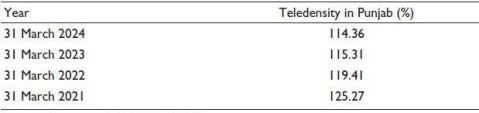
Table 2 highlights the teledensity in Punjab for the past 4 years.
It can be observed from the table that teledensity in Punjab has remained almost the same over 2021–2024. As of 31 March 2024, teledensity stands at 114.36% in Punjab.
Table 2. Teledensity in Punjab
Source: Anonymous (2021, 2023, 2024b)
Theories for Technology Adoption
The success of any technology depends upon the willingness of users to adopt it. Despite the various benefits, some technologies fail miserably due to their complex nature and limited purpose. Adoption can be defined as the continuous use of a product or service (Safeena et al., 2011). To persuade customers to use any service has more to do with behavioural intention (Cudjoe et al., 2015).
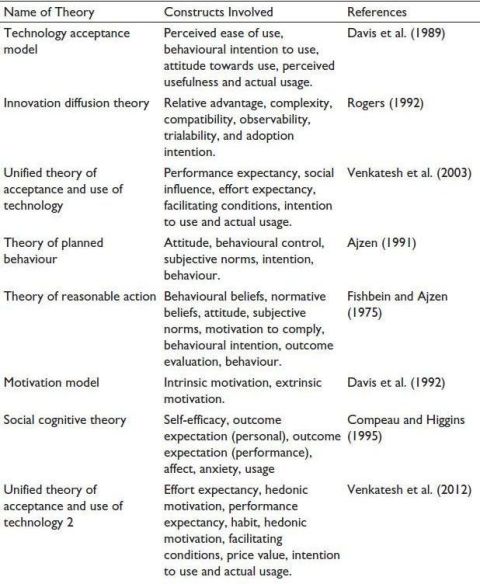
There are various models that explain the process of behavioural intention to adopt any new technology. These are the Technology Acceptance Model, Innovation Diffusion Theory, Task Technology Fit, Motivation Model, Unified Theory of Acceptance and Use of Technology, Theory of Planned Behaviour, Theory of Reasonable Action, Information System Success Model, Social Cognitive Theory and Unified Theory of Acceptance and Use of Technology 2. They help in exploring various factors influencing the attitude of users towards any new technology. New variables can be added to the existing models to meet the objectives of research.
Table 3 highlights the various theories and the constructs involved in technology adoption.
Table 3. Theories for Technology Adoption.
Advantages of Mobile Banking
Mobile banking has an edge over traditional banking channels. Competitive advantage, convenience and cost reduction motivate the banks in their adoption of mobile banking (Dash et al., 2014). All the services of the bank can be accessed with one click from anywhere, anytime. The mobile phone offers the convenience to the customers to conduct any financial transaction and offers the potential for financial growth and financial inclusion (Kadalarasane, 2015). Customers can now avail banking services from any geographical location around the clock according to their convenience. Through the internet, the geographical boundaries are eliminated (Premalatha & Sundaram, 2014). Mobile banking applications also allow users to download their e-passbooks and bank statements on a real-time basis.
To provide security in mobile banking, banks are constantly improving customer care services to prevent any mishap. Through mobile technology and SMS services, customers can track all their account transactions. Continuous upgradation of technology helps banks to design their applications in order to improve privacy, authenticity and security.
Mobile banking cuts down the huge transaction costs of the banks. It also reduces the dependence of banks on the staff, thus reducing the pressure on bankers. Customers save a great deal of time and energy by accessing banking services through mobile phones instead of personally visiting banks and standing in long queues. Mobile banking strengthens customer relationships and loyalty.
Mobile banking applications allow banks to redefine their traditional channels of providing services. Now, banks can offer their services to different groups without any hassle. It allows cross-selling, which means that customers who have access to mobile banking have more product holdings as compared to branch-only customers. This service also makes way for personalised communication. Users can even pay their bills and purchase various policies with a single click on their devices.
Due to enhanced security features, mobile banking applications are now a more secure means to conduct banking transactions. In addition to username and password, these applications now require a finger scan, OTP or even a face scan to access the account. Applications are also encrypted to prevent any theft of personal data.
Constraints in Mobile Banking
Mobile banking is a relatively new concept in India, and very few people are aware of its usage and benefits. It requires a lot of effort by the government and the banks to reach the masses. Moreover, education levels and financial literacy in the rural areas are so low that it becomes difficult to include them in a financial umbrella any time soon. People lack the technical skills essential to operating the mobile banking application.
Privacy and trust issues are the major constraints in the success of electronic applications (Liu et al., 2005). Despite several safety measures taken by the banks to prevent fraud and leakage of data, there is always a risk to the security, reliability and authenticity of the application.
Mobile banking applications do not come totally free of cost. It requires users to have a smartphone such as Apple iPhone, Android phones and so on, a subscription to a good internet connection and text message service by the banks. Although these fees are not significant, they come at a price. Also, some banks charge extra fees for certain mobile banking services.
Review of Literature
Continuous advancements in the field of financial technology are a major breakthrough, resulting in reduced cost and standardised service offerings (Ibrahim et al., 2006). Payment, advisory service, compliance and finance are the major categories of financial technology (Leong & Sung, 2018). Mobile Banking enables conducting bank transactions through a mobile device or mobile terminal (Verma & Nehra, 2016).
Increasing penetration of mobile technologies in the backward communities has made financial inclusion possible (Medhi et al., 2009). Although the adoption of mobile banking is in its initial stages. Dapp et al. (2014) emphasised the need for investment in new financial innovations by the banking sector. Mobile users can be categorised into three main clusters based on their perception, namely: technology adoption laggards, technology adoption followers and technology adoption leaders. In the previous research, various factors have been identified that influence the adoption of mobile banking. Both attitude and intention towards mobile banking vary significantly across these segments (Chawla & Joshi, 2018). Trust in the technology has a predominant part in its adoption (Koksal, 2016). It has a strong and significant effect towards the mobile banking adoption (Hanafizadeh et al., 2014; Mashhour & Saleh, 2015). Furthermore, consumers’ perceptions of knowledge availability, resources and opportunities critical for usage of the service, along with the pressure of both interpersonal and external social contexts towards the use of mobile banking, are important adoption drivers (Giovanis et al., 2019). Some other antecedents towards mobile banking adoption have been found, namely competitive advantage, mobile phone penetration, security concerns, customer convenience, strategic importance, customer demand and low perceived risk (Mullan et al., 2017). Karjaluoto & Huhtamäki (2010) highlighted the role of guidance and information provided by banks for reducing the barrier to the adoption of mobile banking. Carmi and Drezner (2019) stated that periods of service unavailability or long waiting times when implementing an application have a significant influence on customer usage.
In spite of the benefits of mobile banking, people are still reluctant to adopt mobile banking services. Lee et al. (2003) predicted that the mobile banking services usage is hampered by the risk perceptions of consumers. They identified risk in six dimensions, namely physical, time, psychological, financial, performance and social risk. Bamoriya and Singh (2011) highlighted that the operability of mobile handsets, security and privacy and standardisation of mobile banking services were some of the major issues that hampered the growth of mobile banking adoption. Luo et al. (2012) elucidated that well-developed e-banking systems, such as ATMs, are the main reasons for the lack of m-banking channels.
Conclusively, although there is extensive research on mobile banking adoption and its models, some of the aspects have not been touched upon, for example, a comparison of factors influencing behavioural intention towards mobile banking adoption between rural and urban users.
Research Methodology
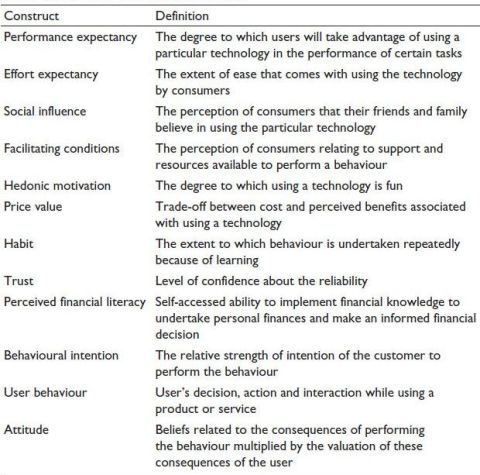
To achieve the objectives of the study, data were collected from the rural and urban areas of Punjab. The districts were selected on the basis of the largest population as per the 2011 census. The three selected districts were Ludhiana, Jalandhar and Amritsar in Punjab. The population of Punjab, as per the 2011 census, is 2,77,43,338, of which Ludhiana is the most populated district. A list of both rural and urban bank branches of the banks operating in selected cities was prepared. A multistage sampling procedure was adopted for the sample selection. In the first stage of sample selection, three rural and three urban bank branches were randomly selected from the prepared list of bank branches from each selected district. In the second stage of sample collection, 30 bank customers were selected from each selected branch using systematic random sampling in terms of selecting the 5th customer entering the bank branch premises. Data was collected from 540 respondents, equally divided between rural and urban mobile banking. The data was collected both by direct contact and through Google Forms. Data were collected between 1 January 2023 and 30 August 2023. The present study has used the UTUT2 model (Venkatesh et al., 2012) with two additional variables, namely trust and attitude, as a conceptual model to explore the factors influencing behavioural intention in the adoption of mobile banking. Table 4 depicts the definitions of different constructs used in the study. The model thereby included effort expectancy, performance expectancy, trust, social influence, price value, facilitating conditions, attitude, habit, hedonic motivation, user behaviour and behavioural intention.
Table 4. Definitions of Different Constructs.
To examine the collected data, the partial least squares structural equation modelling (PLS-SEM) technique was adopted with SmartPLS4. It is a non-parametric technique undertaken for measuring explained variance in latent constructs. In model testing, a two-step approach was used; reliability and validity were first tested in the outer model, and then hypothesis testing in the proposed conceptual model of mobile banking adoption was tested in the second stage. For calculating the reliability and validity of the study in the outer model, the statistics suggested by Hair et al. (2019) and Kline (2023) were used. These statistics include internal consistency, convergent validity, composite reliability (CR) and discriminant validity
Standardised factor loadings were calculated for each indicator of the construct. Reliability was ensured by calculating Cronbach’s alpha (CA) and CR. To ensure reliability, the values of both should be greater than 0.70. To ensure convergent validity, average variance extracted (AVE) should be greater than 0.5, and factor loadings should be greater than 0.70. Fornell–Larcker criterion method and Heterotrait–Monotrait method ratio (HTMT) were employed to check discriminant validity. HTMT should be less than 0.85 to ensure discriminant validity (Hair et al., 2019).
To calculate the path coefficient along with its associated t-value for direct, mediating and moderating relationship bootstrapping method was implemented. Using multigroup analysis in Smart PLS 4.0, significant differences were assessed between rural and urban respondents in factor loadings and structural path coefficients of the proposed mobile banking adoption model.
Results and Discussion
The data gathered through questionnaires was further analysed using SPSS for frequency analysis. Table 5 shows the demographic and economic profile of the respondents and their respective frequency percentages.
Table 5. Descriptive Statistics.
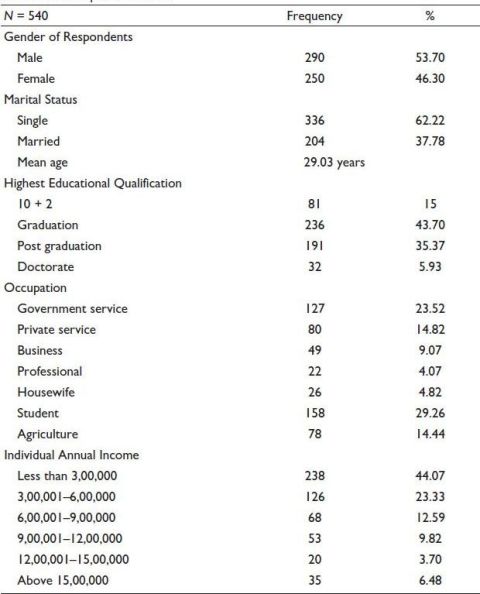
Out of 540 respondents, 53.70% were male and 46.30% were female. Further, out of the total sample size of 540 respondents, 62.22% were single, and 37.78 were married at the time of data collection. The mean age of respondents was found to be 29.03 years with a standard deviation of 8.53. Educational qualification of respondents was categorised into five categories, namely 10 + 2, graduation, post-graduation and doctorate. It was found that the maximum number of respondents are graduates (43.70%). The minimum number of respondents is doctorates (5.93%). Occupation was categorised into seven categories, namely government service, private service, business, professional, housewife, student and agriculture. The highest number of respondents were students (29.26%), and the least were professionals (4.07%).
Annual individual income of respondents was categorised into six categories, namely less than .png) 300,000, 300,001–600,000, 600,001–900,000, 900,001–1,200,000, 1,200,001–1,500,000, and above 1,500,000. The maximum number of respondents have an income of less than 300,000.
300,000, 300,001–600,000, 600,001–900,000, 900,001–1,200,000, 1,200,001–1,500,000, and above 1,500,000. The maximum number of respondents have an income of less than 300,000.
The proposed model as indicated in Figure 1 under the study was examined using the PLS-SEM technique with the help of Smart PLS 4.0 (Ringle et al., 2022). The testing of the measurement model examines the relationship between observed and latent variables (Hair et al., 2019). Data was collected using numerical values for all items of the latent constructs. Table 6 depicts the results of the measurement model. Construct reliability of the measurement model was established as both CA and CR values were over 0.70 (Hair et al., 2019). Convergent validity was confirmed as values of all factor loadings were higher than 0.708, and AVE was above 0.50 (Hair et al., 2009).
Figure 1. Mobile Banking Adoption (Revised UTAUT2) Model.
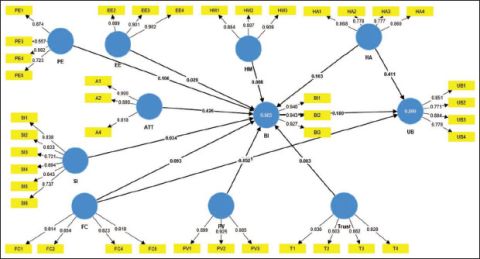
Table 6. Measurement Model: Mobile Banking Adoption Model (Reliability and Validity).
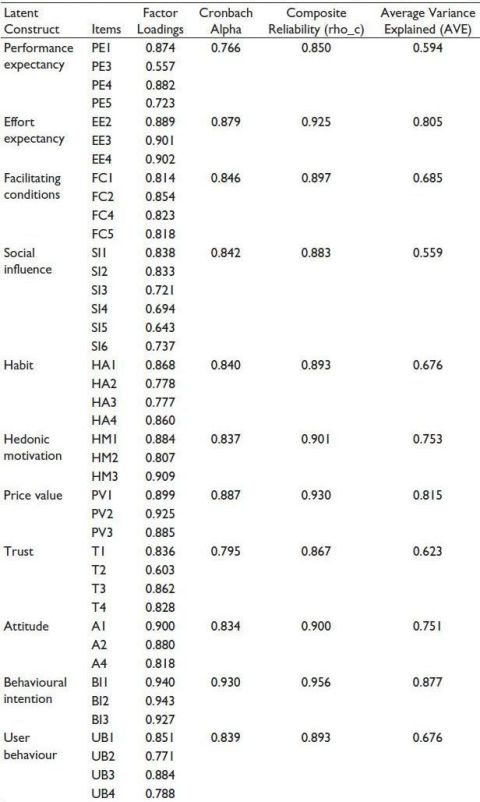
Performance expectancy included five items, out of which PE2 was deleted because of a factor loading less than 0.50. For the included statements, it ranged from 0.557 to 0.882. The construct of performance expectancy had a CA of 0.766 and a CR of 0.850. The AVE explained by performance expectancy was recorded at 0.594. Effort expectancy included four items, out of which EE1 was deleted because of a factor loading less than 0.50. The factor loadings of the included statements were between 0.889 and 0.902. The construct of effort expectancy had a CA of 0.879 and a CR of 0.925. The AVE explained by performance expectancy was recorded at 0.805.
Facilitating Conditions included five items, out of which FC3 was deleted because of factor loading less than 0.50. For the included statements, it ranged from 0.814 to 0.854. The construct of facilitating conditions had a CA of 0.846 and a CR of 0.897. The AVE explained by facilitating conditions was recorded at 0.685. Social influence included six items, and factor loadings of the included statements ranged between 0.643 and 0.838. Social influence had a CA of 0.842 and a CR of 0.883. The AVE explained by performance expectancy was recorded at 0.559. The habit included four items, and factor loadings of the included statements ranged between 0.777 and 0.868. The construct of habit had a CA of 0.840 and a CR of 0.893. The AVE explained by habit was recorded at 0.676. Hedonic motivation included three items, and factor loadings of the included statements ranged between 0.807 and 0.909. The construct of hedonic motivation had a CA of 0.837 and a CR of 0.901. The AVE explained by hedonic motivation was recorded at 0.753.
Price value included three items, and factor loadings of the included statements ranged between 0.885 and 0.925. The construct of price value had a CA of 0.887 and a CR of 0.930. The AVE, explained by price value, was recorded at 0.815. Attitude included four items, out of which A3 was deleted because of factor loading less than 0.50. The factor loadings of the included statements ranged between 0.818 and 0.900. The construct of attitude had a CA of 0.834 and a CR of 0.900. The AVE explained by attitude was recorded at 0.751. Trust included four items, and factor loadings of the included statements ranged between 0.603 and 0.862. The construct of trust had a CA of 0.795 and a CR of 0.867. The AVE explained by trust was recorded at 0.623. Behavioural intention included three items, and factor loadings of the included statements ranged between 0.927 and 0.943. The construct of behavioural intention had a CA of 0.930 and a CR of 0.956. The AVE explained by behavioural intention was recorded at 0.877. The construct of user behaviour included four items, and factor loadings of the included statements ranged between 0.771 and 0.884. The construct of user behaviour had a CA of 0.839 and a CR of 0.893. The AVE explained by user behaviour was recorded at 0.676.
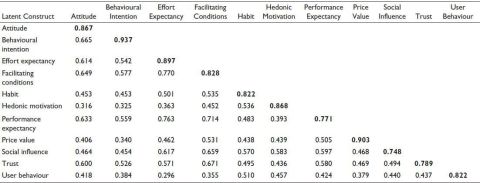
Discriminant validity is used to confirm that latent variables are unrelated to each other and that each latent variable is unique. According to Fornell and Larcker (1981), the square root of AVE should be higher than the correlations to ensure discriminant validity. As illustrated by Table 7 , all the square roots of AVE values were higher than inter-construct correlation coefficients.
Table 7. Discriminant Validity: Fornell–Larcker Criterion (Mobile Banking Adoption Model).
HTMT is a measure of discriminant validity in the PLS-SEM approach (Hair et al., 2019). Discriminant validity is ensured When the HTMT value is less than 0.90, discriminant validity is ensured. The results indicate that all the latent variables were unique, as all the HTMT values, as shown by Table 8, are less than 0.90, thus ensuring discriminant validity.
Table 8. Discriminant Validity: Heterotrait–Monotrait Ratio (Mobile Banking Adoption Model).
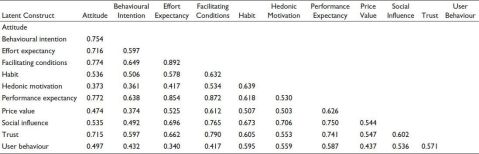
Table 9 depicts notable variations between rural and urban respondents in terms of various items of different factors influencing behavioural intention towards mobile banking adoption. The results revealed that most of the factor loading differences among different items between rural and urban respondents were non-significant, except for two items. The factor loading difference was significant for Hedonic Motivation ? HM1 (p = .044). The difference in path coefficients revealed that the impact of HM1 was stronger among urban respondents. The results also found the significant factor loading difference for Performance Expectancy ? PE1 (p = .043). The difference in path coefficients revealed that the impact of PE1 was stronger among rural respondents.
Table 9. Multigroup Analysis (Factor Loading Difference Between Rural and Urban)
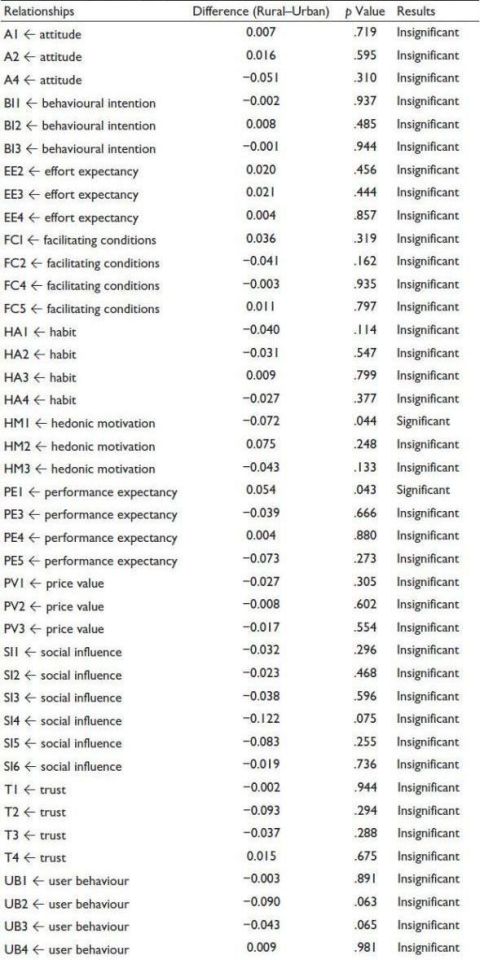
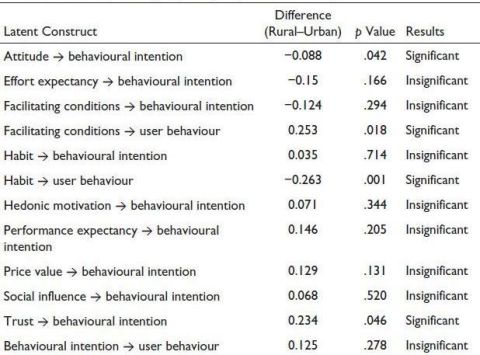
Table 10 depicts multigroup analysis for the difference between rural and urban areas for different constructs. The findings revealed path coefficients, namely Attitude ? Behavioural Intention (coefficient = ?0.088, p = .042), Facilitating Conditions ? User Behaviour (coefficient = 0.253, p = .018), Habit ? User Behaviour (coefficient = ?0.263, p = .001) and Trust ? BI (coefficient = 0.234, p = .046), were found to be significantly different between urban and rural respondents.
Table 10. Bootstrap Multi-group Analysis (Structural Model).
Limitations for the Study
Conclusion
It is well acknowledged that the banking sector is the backbone of the Indian financial system. Banking plays a predominant role in financial inclusion in every economy. The Indian banking sector has undergone drastic change over the years. Various innovations and new products have swept into the financial market to make banking easier and more convenient. The banking sector has outpaced all other sectors in the adoption of new technologies. Mobile banking is one such innovation. Mobile banking involves using mobile phones for banking services. Mobile banking offers various advantages over traditional methods of banking. Convenience, saving of time and effort and cost reduction offer a competitive edge over other methods of banking, but at the same time, security and privacy concerns have hampered the growth of adoption of mobile banking. The present research has undertaken a comparative study of rural and urban users for factors affecting behavioural intention towards mobile banking adoption. The study highlighted significant structural differences between rural and urban respondents’ structural relationships, namely attitude ? behavioural intention, habit ? user behaviour and trust ? behavioural intention.
Declaration of Conflicting Interests
The author declared no potential conflicts of interest with respect to the research, authorship and/or publication of this article.
Funding
The author received no financial support for the research, authorship and/or publication of this article.
ORCID iD
Charvy Narang https://orcid.org/0009-0006-4215-1183
Ajzen, I. (1991). The theory of planned behavior. Organizational Behavior and Human Decision Processes, 50(2), 179–211.
Alampay, E. A., & Moshi, G. C. (2018). Impact of mobile financial services in low-and lower-middle-income countries: A systematic review. Information Technologies & International Development, 14, 164–181.
Anonymous. (2011). Telecom Regulatory Authority of India. https://trai.gov.in/sites/default/files/ Consultationerdiv25jan11.pdf
Anonymous. (2021). Telecom Regulatory Authority of India. https://trai.gov.in/sites/default/files/ PR_No.33of2021_0.pdf
Anonymous. (2023). Telecom Regulatory Authority of India. https://trai.gov.in/sites/default/files/ PR_No.46of2023_0.pdf
Anonymous. (2024a). India mobile payments. https://www.ceicdata.com/en/india/mobile-payments
Anonymous. (2024b). Telecom Regulatory Authority of India. https://trai.gov.in/sites/default/files/ PR_No.23of2024_0.pdf
Bamoriya, P. S., & Singh, P. (2011). Issues & challenges in mobile banking in India: A customers’ perspective. Research Journal of Finance and Accounting, 2, 112–120.
Bitner, M. J., Ostrom, A. L., & Meuter, M. L. (2002). Implementing successful self-service technologies. Academy of Management Perspectives, 16, 96–108.
Carmi, G., & Drezner, N. (2019, May). Influence factors on the adoption of a financial application. In InSITE 2019: Informing Science + IT Education Conferences, Jerusalem (pp. 227–229).
Chawla, D., & Joshi, H. (2018). The moderating effect of demographic variables on mobile banking adoption: An empirical investigation. Global Business Review, 19(3_suppl), S90–S113.
Compeau, D. R., & Higgins, C. A. (1995). Computer self-efficacy: Development of a measure and initial test. MIS Quarterly, 19(2), 189–211.
Cudjoe, A. G., Anim, P. A., & Nyanyofio, J. G. N. T. (2015). Determinants of mobile banking adoption in the Ghanaian banking industry: A case of access bank Ghana limited. Journal of Computer and Communications, 3(2), 1–19.
Dash, M. A. N. O. R. A. N. J. A. N., Bhusan, P. B., & Samal, S. (2014). Determinants of customers’ adoption of mobile banking: An empirical study by integrating diffusion of innovation with attitude. Journal of Internet Banking and Commerce, 19(3), 1–21.
Dapp, T., Slomka, L.., AG, D. B., & Hoffmann, R. (2014). Fintech–The digital (r) evolution in the financial sector. Deutsche Bank Research, 11, 1–39.
Davis, F. D., Bagozzi, R. P., & Warshaw, P. R. (1989). User acceptance of computer technology: A comparison of two theoretical models. Management Science, 35(8), 982–1003.
Fishbein, M., & Ajzen, I. (1975). Belief, attitude, intention, and behavior: An introduction to theory and research. Addison-Wesley.
Fornell, C., & Larcker, D. F. (1981). Evaluating structural equation models with unobservable variables and measurement error. Journal of Marketing Research, 18, 39–50.
Giovanis, A., Athanasopoulou, P., Assimakopoulos, C., & Sarmaniotis, C. (2019). Adoption of mobile banking services: A comparative analysis of four competing theoretical models. International Journal of Bank Marketing, 37(5), 1165–1189.
Gupta, V. K., Bagoria, R., & Bagoria, N. (2013). Mobile banking services as adoption and challenges: a case of m-banking in India (positive and negative impacts, mobile growth in India, adoption models and mobile technology). International Journal of Scientific and Research Publications, 3(1), 1–6.
Hair, J. F., Risher, J. J., Sarstedt, M., & Ringle, C. M. (2019). When to use and how to report the results of PLS-SEM. European Business Review, 31, 2–24.
Hanafizadeh, P., Behboudi, M., Koshksaray, A. A., & Tabar, M. J. S. (2014). Mobile-banking adoption by Iranian bank clients. Telematics and Informatics, 31(1), 62–78.
Ibrahim, E. E., Joseph, M., & Ibeh, K. I. (2006). Customers’ perception of electronic service delivery in the UK retail banking sector. International Journal of Bank Marketing, 24(7), 475-493.
Kadalarasane, T. (2015). Acceptance of mobile banking services: Antecedents and consequences (Doctoral dissertation). Pondicherry University.
Karjaluoto, H., & Huhtamäki, M. (2010). The role of electronic channels in micro-sized brick-and-mortar firms. Journal of Small Business & Entrepreneurship, 23(1), 17–38.
Kline, R. B. (2023). Principles and practice of structural equation modeling. Guilford Publications.
Koksal, M. H. (2016). The intentions of Lebanese consumers to adopt mobile banking. International Journal of Bank Marketing, 34(3), 327–346.
Lee, K. W., Kim, Y. J., Kim, D. O., Lee, H. J., & Lee, C. Y. (2003). Major phenolics in apple and their contribution to the total antioxidant capacity. Journal of Agricultural and Food Chemistry, 51(22), 6516–6520.
Leong, K., & Sung, A. (2018). FinTech (Financial Technology): What is it and how to use technologies to create business value in fintech way?. International Journal of Innovation, Management and Technology, 9(2), 74–78.
Liu, S. H., Liao, H. L., & Peng, C. J. (2005). Applying the technology acceptance model and flow theory to online e-learning users’ acceptance behavior. E-learning, 4(H6), H8.
Luo, X., Lee, C. P., Mattila, M., & Liu, L. (2012). An exploratory study of mobile banking services resistance. International Journal of Mobile Communications, 10(4), 366-385.
Mashhour, A. S., & Saleh, Z. (2015). Community perception of the security and acceptance of mobile banking services in Bahrain: An empirical study. International Journal of Advanced Computer Science and Applications, 6, 45–54.
Medhi, I., Ratan, A., & Toyama, K. (2009, July). Mobile-banking adoption and usage by low-literate, low-income users in the developing world. In International conference on internationalization, design and global development (pp. 485–494). Springer Berlin Heidelberg.
Mittal, R. (2004). Online copyright infringement liability of internet service providers. Journal of the Indian Law Institute, 46, 288–321.
Mohapatra, M. R., Moirangthem, N. S., & Vishwakarma, P. (2020). Mobile banking adoption among rural consumers: Evidence from India. American Business Review, 23, 300–315.
Mullan, J., Bradley, L., & Loane, S. (2017). Bank adoption of mobile banking: Stakeholder perspective. International Journal of Bank Marketing, 35, 1154–1174.
Owuamanam, J. N., Abdullah, S., Jusoh, Y. Y., & Pa, N. C. (2022). E-service quality model for assessing customer satisfaction of mobile banking Service. 2022 Applied Informatics International Conference (AiIC) (pp. 178–183). IEEE.
Premalatha, J. R., & Sundaram, N. (2014). Reasons for non-adoption of internet banking: A study with reference to Vellore district of Tamil Nadu, India. Asian Social Science, 10(8), 116.
Ringle, C. M., Becker, J. M., Cheah, J. H., & Sarstedt, M. (2022). PLS-SEMs most wanted guidance. International Journal of Contemporary Hospitality Management, 16, 45–64.
Rogers, E. M. (1992). Prospectus for a cooperative extension system in education. Knowledge, 13(3), 248–255.
Safeena, R., Date, H., & Kammani, A. (2011). Internet banking adoption in an emerging economy: Indian consumer’s perspective. International Arab Journal of E-Technology, 2, 56-64.
Tan, M., & Teo, T. S. H. (2000). Factors influencing the adoption of internet banking. Journal of the Association for Information Systems, 1, 1–42.
Venkatesh, V., Morris, M. G., Davis, G. B., & Davis, F. D. (2003). User acceptance of information technology: Toward a unified view1. MIS Quarterly, 27(3), 425–478.
Verma, D., & Nehra, V. S. (2016). Determinants of adoption behaviour towards mobile banking services: A study of Indian consumers. International Journal of Research and Analytical Reviews, 3.
Venkatesh, V., Thong, J. Y., & Xu, X. (2012). Consumer acceptance and use of information technology: Extending the Unified Theory of Acceptance and Use of Technology1. MIS Quarterly, 36(1), 157–178.
