
Gyan Management


Mehak Goyal1 , Vishal Vinayak1 and Yashmin Sofat2
1Department of Commerce and Management, RIMT University, Mandi Gobindgarh, Punjab, India
2Department of Commerce, A.S. College, Khanna, Punjab, India

Creative Commons Non Commercial CC BY-NC: This article is distributed under the terms of the Creative Commons Attribution-NonCommercial 4.0 License (http://www.creativecommons.org/licenses/by-nc/4.0/) which permits non-Commercial use, reproduction and distribution of the work without further permission provided the original work is attributed.
This study aims to identify the key factors driving consumer adoption of electric vehicles (EVs) and to assess how various information sources influence consumer awareness and purchase intent within the context of sustainable urban mobility. A mixed-methods approach was utilized, analyzing primary data gathered via a structured questionnaire from 450 respondents in Ludhiana, supplemented by secondary data from academic and industry sources. The data were analyzed using statistical techniques to identify core behavioral dimensions influencing consumer choice. The analysis reveals that consumer preferences are significantly shaped by environmental, technological, and social factors. Environmental concern emerged as the single strongest motivator for EV adoption. Critically, information sources—particularly social media—were found to play a vital role in both building awareness and driving purchase intentions. The findings underscore a challenge: while high environmental awareness fosters positive attitudes, limited consumer information, and perceived performance uncertainties continue to impede adoption. These insights provide valuable direction for policymakers and manufacturers to develop targeted public awareness campaigns and strategies focused on boosting consumer confidence.
Consumer behavior, electric vehicles, information sources, factor analysis, sustainable mobility
Introduction
The transportation sector is experiencing a significant shift due to the increasing demand for sustainable mobility solutions. Escalating environmental challenges, diminishing fossil fuel reserves, and rising levels of urban air pollution have accelerated the global transition from conventional internal combustion engine vehicles to electric vehicles (EVs). EVs are widely regarded as environmentally friendly and energy-efficient alternatives, with considerable potential to lower greenhouse gas emissions and decrease reliance on non-renewable energy resources.
In India, the adoption of electric mobility is increasing due to supportive government policies and technological improvements. Nevertheless, EV market penetration remains modest, as consumers still face persistent barriers related to cost, performance perceptions, and inadequate charging infrastructure. While Punjab, particularly its industrial hub Ludhiana, shows a positive trend in EV uptake, this localized progress underscores the critical need to understand the underlying behavioral determinants of consumer decisions.
Problem Statement
Understanding consumer behavior is crucial in accelerating EV adoption, especially in dynamic regional markets. Consumer decisions are determined by a multidimensional interaction of economic, technological, environmental and social factors, alongside the growing influence of information sources such as social media. Despite the significance of these factors, there is a critical gap in empirical research focusing specifically on consumer behavior toward EV adoption in Ludhiana. Local adoption patterns often deviate significantly from national trends due to unique market characteristics and regional barriers. To overcome this research gap, the study analyzes not only the drivers of consumer interest but also the specific local constraints that restrict widespread acceptance.
Theoretical Grounding
The foundation of this research is rooted in established behavioral and technology adoption frameworks:
Review of Literature
Environmental and Sustainability Orientation
Environmental consciousness is consistently identified as a primary catalyst for EV interest and adoption. Axsen and Kurani (2008) investigated US consumers’ preferences and confirmed that perceived environmental benefits, such as reduced gasoline consumption, drive initial interest, despite low initial awareness. This finding is mirrored in developing regions, where studies confirm the central role of sustainability. For example, Siregar et al. (2024) found that environmental sustainability was a top-rated factor influencing battery electric vehicle user satisfaction in Jakarta.
Critical synthesis: While environmental motivation creates a strong positive attitude toward EVs, the literature suggests it is often insufficient to guarantee high adoption rates. Consumers frequently trade off ecological benefits against practical and economic concerns (cost and infrastructure), indicating that motivation alone does not overcome market friction.
Technological Perception, Performance, and Infrastructure
Technology-related attributes, especially those tied to practical utility, significantly modulate consumer behavior. Factors such as charging speed, battery range, and infrastructure accessibility are critical determinants of confidence. Lee et al. (2021) found wide demographic variance in satisfaction with EV charging infrastructure, noting that access to home charging led to higher satisfaction among younger, higher-income users.
Siregar et al. (2024) similarly highlighted that inadequate charging location availability remains a major barrier, even when policy support is strong. Singh et al. (2020) also categorized charging infrastructure as a dominant contextual predictor.
Critical synthesis: The evidence strongly suggests that perceived performance risk and infrastructure inadequacy are key impediments to mass adoption. Improving charging availability, speed, and safety are necessary preconditions for building the user confidence required to accelerate market penetration, especially in densely populated urban environments with nascent infrastructure.
Psychological and Social Influences
Beyond rational economic and technical factors, psychological and social dimensions play a powerful role in the decision-making process. Singh et al. (2020) conducted a meta-analysis emphasizing that positive attitudes toward EVs and social influence (peer norms, community acceptance) are significant predictors of adoption across global regions. They asserted that psychological factors can be as influential as economic considerations.
Theoretical grounding: This finding aligns with the diffusion of innovation (DOI) theory, where social influence dictates the spread of new technologies, and the TAM, where positive attitudes reinforce perceived usefulness. Consequently, strategies must focus on building trust, correcting misconceptions, and promoting EVs as socially responsible and aspirational products.
Demographic Factors and Contextual Variation
The effect of age, income, and education on consumers’ decisions to adopt EVs is not straightforward and context-dependent. Lee et al. (2021) identified strong demographic variations in satisfaction with charging infrastructure, indicating that demographics interact significantly with technological access.
Conversely, Meet et al. (2025), studying consumers in Ahmedabad, found that age was a minor influence on satisfaction, with practical considerations (cost-effectiveness, convenience, and maintenance) being far more influential.
Critical synthesis: While demographic factors provide useful segmentation data, the literature confirms that their influence is not universal. Research must avoid generalizing demographic impacts and instead focus on how these factors interact with local infrastructure realities and specific consumer priorities.
Research Gaps
Despite a robust body of literature identifying the dominant factors (environmental concern, infrastructure, and social influence) influencing EV adoption globally, several gaps persist, particularly at the regional level:
Research Methodology
Need and Significance of the Study
Objectives
Research Design
This study adopts a descriptive–analytical research design. The descriptive aspect examines consumers’ level of awareness, attitudes, and perceptions toward EVs in Ludhiana. The analytical aspect explores the key behavioral factors affecting EV adoption and evaluates the influence of different information sources through the application of appropriate statistical methods like weighted average score (WAS) and exploratory factor analysis (EFA) (Hair et al., 2019).
Scope of the Study
The study focuses exclusively on consumers residing in Ludhiana, Punjab, examining their perceptions, awareness, and behavioral intentions related to electric two-wheelers and four-wheelers available in the Indian market. The scope is centered on consumer behavior and information exposure, deliberately excluding technical, mechanical, or engineering dimensions of EVs.
Collection of Data
Primary Data
Primary data were gathered through a structured questionnaire consisting of closed-ended questions and Likert-scale statements. The questionnaire was organized into four major sections: demographic profile, behavioral factors, information sources, and purchase intention. Data were collected over a two-month period via both in-person administration and online forms.
Secondary Data
Secondary information was sourced from:
Sampling Method
Statistical Tools and Techniques
The integrated analysis was performed using SPSS software.
Reliability and Validity of the Instrument
Reliability: The internal reliability of the constructs was verified by ensuring that all Cronbach’s α coefficients exceeded the accepted benchmark of 0.70 (George & Mallery, 2019).
Validity:
Role of Various Information Sources on the Level of Awareness Among Consumers Regarding EVs in Ludhiana
Application of WAS
Table 1 presents the WAS calculated to assess the influence of various information sources on consumer awareness about EVs in Ludhiana. Respondents ranked 11 different sources based on their perceived importance in shaping awareness.
Interpretation:
1. Social media (WAS = 6.4467, rank 1)
Social media emerged as the most influential awareness source. Platforms such as Instagram, Facebook, YouTube, and X provide review-based and visual content that helps consumers form quick impressions. Younger and tech-savvy individuals rely heavily on these channels for real-time updates, launch announcements, and user experiences. The highest WAS score reflects the effectiveness of digital campaigns by EV brands and state initiatives.
Table 1. Showing Awareness Level of Consumers.
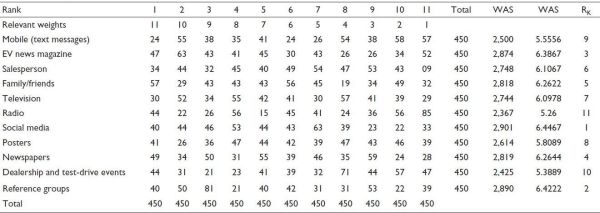
2. Reference groups (WAS = 6.4222, rank 2)
Reference groups, including peers, colleagues, and community members, play a crucial role. Consumers rely on real-life experiences shared by trusted individuals. Social influence and word of mouth act as credibility enhancers in reducing doubts regarding performance and charging.
3. EV news magazines (WAS = 6.3867, rank 3)
This shows that a segment of consumers actively seeks specialized and reliable EV information. These publications offer technical clarity, battery-related updates, and market trends. They appeal most to informed buyers, early adopters, and environmentally conscious individuals.
4. Newspapers (WAS = 6.2644, rank 4)
Newspapers remain relevant in shaping policy-level awareness. Coverage on subsidies, schemes, and charging infrastructure continues to engage mid-aged and older readers. However, newspapers provide less personalized guidance compared to digital media.
5. Family and friends (WAS = 6.2622, rank 5)
Family circles influence early EV interest and shape awareness. Shared experiences, suggestions, and practical advice create authentic perceptions. These interpersonal channels maintain importance despite digital media dominance.
6. Salespersons (WAS = 6.1067, rank 6)
Salespersons influence decisions during in-person dealership interactions. However, the impact is moderate due to perceived commercial bias. The result indicates a training need for more technical and consultative communication.
7. Television (WAS = 6.0978, rank 7)
TV remains a mass-awareness medium but lacks interactivity. Effective for reach but less impactful compared to targeted online ads.
8. Posters (WAS = 5.8089, rank 8)
Posters serve branding and visibility purposes but do not provide in-depth information.
9. Mobile text messages (WAS = 5.5556, rank 9)
Low influence due to the high frequency of promotional messaging. Personalization and targeted notifications could increase effectiveness.
10. Dealership events and test drives (WAS = 5.3889, rank 10)
Events have potential but limited reach. Their lower score suggests weak promotion or a lack of consumer initiative to attend. Event success may improve when integrated with social media campaigns.
11. Radio (WAS = 5.26, rank 11)
Radio has the least impact due to its non-visual and short-format content. Still useful for quick government alerts or promotional jingles.
Figure 1. Conceptual Model: Factor Analysis Structure.
Source: Researcher’s compilation.
Application of EFA
The primary objective is to use the EFA technique to evaluate and group the key variables (statements) that influence the level of awareness, perception, and intention to adopt EVs among consumers in Ludhiana, Punjab.
Extraction of Factors
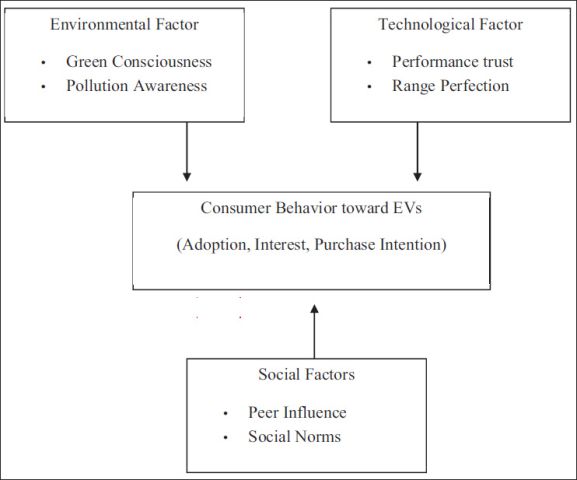
The fundamental features of various information sources were ascertained through the application of EFA (Figure 1). Using a Likert scale with a maximum score of five and a range from strongly disagree to strongly agree, the respondents were asked to rank ten different factors. As can be seen from Table 2, all components with loadings more than 0.5 were considered good. In the particular situation, loadings ranged from 0.741 to 0.878. Items that had loading factors below 0.5 were excluded. The eigenvalues of the three resultant factors range from 1.117 to 5.429, as shown in Table 2.
Environmental Consciousness (Factor 1)
Eigenvalue = 5.429 | Variance explained = 54.29% | α = 0.941
This factor emerged as the strongest determinant of consumer awareness.
Table 2. Factor Analysis Results for EVs.
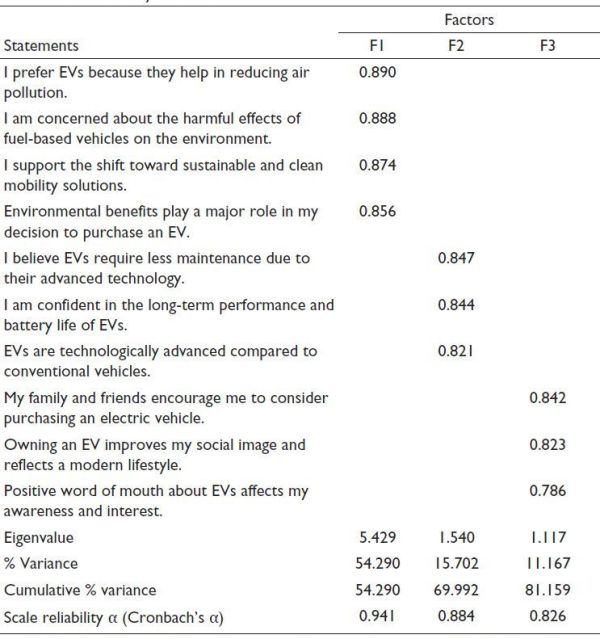
Cronbach’s α = 0.895, Bartlett’s test of sphericity (approximate χ2) = 3,345.707, DF = 45, Sig. = 0.000, Kaiser–Meyer–Olkin measure of sampling adequacy = 0.880, mean = 36.99.
Key insights:
Interpretation: Consumers’ awareness is closely tied to their belief in the ecological advantages of EVs. This aligns with global behavioral trends where environmental concern is a major motivator for clean mobility adoption.
Technological Perception (Factor 2)
Eigenvalue = 1.540 | Variance explained = 15.70% | α = 0.884
This factor highlights trust in EV technology
Key components:
Interpretation: Consumers evaluate EVs based on innovation, reliability, and long-term performance. Awareness increases when consumers trust the technology, implying that technical clarity from manufacturers is essential.
Social Influence and Image (Factor 3)
Eigenvalue = 1.117 | Variance explained = 11.17% | α = 0.826
This factor captures the role of interpersonal encouragement and modern lifestyle appeal.
Elements include:
Interpretation: EV awareness is also shaped by social validation. Peer encouragement and the desire for a “modern lifestyle image” affect interest and awareness, particularly in urban areas.
To Analyze the Challenges Related to the Adoption of EVs in Ludhiana
High Upfront Cost of Electric Vehicles
One of the biggest obstacles to the adoption of EVs in Ludhiana is their high upfront cost compared to conventional petrol and diesel vehicles. The primary reason behind this price gap lies in the expensive lithium-ion battery technology, which accounts for a significant share of the vehicle’s total cost. Although EVs offer lower running and maintenance costs in the long term, the higher initial investment discourages middle-income consumers from purchasing them. Studies from NITI Aayog and SIAM (2023) indicate price sensitivity as a major deterrent.
Lack of Charging Infrastructure
A major infrastructural barrier is the limited availability of public charging stations across Ludhiana. The shortage of charging points contributes to “range anxiety” among potential users, as they fear running out of battery power during travel. According to the Ministry of Power (2024), Punjab has less than one public charger per 100 EVs, which severely limits convenience and practicality for EV users. The absence of fast-charging facilities and inadequate coordination between municipal authorities and private service providers further worsens the problem.
Battery Performance and Replacement Concerns
Battery-related issues, such as uncertainty about performance, durability, and replacement costs, also act as deterrents to EV adoption. Consumers are often concerned about the long-term efficiency of batteries and the high expense involved in replacing them after a few years of use. Moreover, secondary data from TERI (2023) indicate that the lack of proper battery recycling and disposal mechanisms adds to environmental and economic concerns, reducing consumer confidence in the technology.
Low Consumer Awareness and Information Gaps
Another crucial challenge is the limited awareness among consumers regarding EV benefits, available models, government incentives, and maintenance requirements. Many potential buyers in Ludhiana remain unfamiliar with financial subsidies, tax rebates, and state-level incentives under the Punjab Electric Vehicle Policy (2022). The lack of targeted awareness campaigns and limited visibility of EV success stories contribute to the slow pace of adoption.
Inadequate After-sales Service and Technical Support
The unavailability of trained technicians and specialized service centers in Ludhiana presents a significant operational challenge. Many automobile workshops and dealerships are not yet equipped to handle EV-specific repairs or maintenance. As noted in FADA’s (2023) industry report, this lack of technical readiness makes consumers hesitant to invest in EVs, fearing post-purchase complications and delays in service.
Policy Implementation and Procedural Challenges
Although the Punjab government introduced the Punjab Electric Vehicle Policy (2022) with various incentives, the ground-level implementation remains limited. Consumers often face procedural hurdles in availing of subsidies, tax exemptions, or registration benefits. The complexity and lack of clarity in the policy’s communication reduce its effectiveness in encouraging adoption.
Long Charging Time and Practical Inconvenience
Another technical limitation is the long time required to fully charge an electric vehicle compared to the quick refueling of petrol or diesel vehicles. This poses a major inconvenience, especially for individuals who depend on their vehicles for daily commuting or commercial use. The absence of rapid charging infrastructure further adds to this inconvenience, making EVs less suitable for users seeking flexibility and efficiency.
Discussion
The study set out to investigate the factors affecting consumer behavior toward EVs in Ludhiana and to analyze how various information sources shape consumer awareness. The findings from the WAS and EFA provide several insights that align with, and in some cases differ from, existing literature.
Linking the Findings with Past Research
Environmental Factor as the Strongest Predictor
The EFA revealed that environmental consciousness is the most influential factor affecting consumer behavior in Ludhiana. This aligns with Axsen and Kurani (2008) and Singh et al. (2020), who also found environmental concern to be a major driver of EV acceptance. Similar to global findings, Ludhiana consumers associate EVs with reduced pollution and improved sustainability.
However, consistent with studies by Siregar et al. (2024), environmental motivation alone still does not guarantee adoption, indicating a “gap between intention and action,” especially where infrastructure challenges persist.
Technological Trust and Performance Perception
The technological factor emerged as the second most important dimension. This is consistent with Lee et al. (2021), who found that confidence in battery performance, range, and maintenance plays a key role in adoption. In Ludhiana, consumers appreciate the technological superiority of EVs, but concerns about battery life and performance uncertainty mirror global patterns in countries where EV penetration is still growing.
Social Influence and Interpersonal Communication
The social factor—including family influence, peer recommendations, and lifestyle perception— aligns with Singh et al. (2020), who reported that social norms significantly shape EV intentions. Findings from WAS further support this: reference groups ranked second, showing that real-life user experiences strongly affect awareness. This demonstrates that Ludhiana consumers rely more on interpersonal trust when adopting new technologies.
Role of Information Sources
The WAS results highlight that social media is the strongest awareness driver, followed closely by reference groups and EV magazines.
This expands on earlier studies by showing that in semi-urban industrial cities like Ludhiana:
Implications
Implications for Manufacturers
Implications for Policymakers
Implications for Consumers
Conclusion
The study offers insightful information about the informational and behavioral factors influencing EV adoption in Ludhiana. The results show that environmental concern is the strongest motivator influencing consumer awareness, followed by trust in EV technology and social influence. Social media, reference groups, and EV-focused publications play dominant roles in spreading awareness, while traditional media like radio and text messages have minimal impact. Although awareness about EVs is increasing, several challenges—such as high initial costs, limited charging infrastructure, technological uncertainties, low after-sales support, and policy implementation gaps—continue to hinder widespread adoption.
Suggestions for Future Research
Future studies may consider the following:
Declaration of Conflicting Interests
The authors declared no potential conflicts of interest with respect to the research, authorship, and/or publication of this article.
Funding
The authors received no financial support for the research, authorship, and/or publication of this article.
ORCID iD
Mehak Goyal https://orcid.org/0009-0003-0783-2352
Axsen, J., & Kurani, K. S. (2008). The early U.S. market for PHEVs: Anticipating consumer awareness, recharge potential, design priorities and energy impacts. Transportation Research Part A: Policy and Practice, 42(10), 166–177.
Etikan, I., Musa, S. A., & Alkassim, R. S. (2016). Comparison of convenience sampling and purposive sampling. American Journal of Theoretical and Applied Statistics, 5(1), 1–4.
George, D., & Mallery, P. (2019). IBM SPSS statistics 26 step by step: A simple guide and reference. Routledge.
Hair, J. F., Black, W. C., Babin, B. J., & Anderson, R. E. (2019). Multivariate data analysis (8th ed.). Cengage.
Lee, K., Moon, S., & Lee, J. (2021). Demographic influence on user satisfaction with electric vehicle charging. Transportation Research Part D: Transport and Environment, 91, 102709.
Meet, P., Alka, P., & Vidani, J. (2025). A comparative study on consumer satisfaction regarding EV vs petrol vehicle owners in Ahmedabad City. International Journal of Applied Research and Sustainable Sciences, 3(1), 113–132.
Singh, V., Singh, V., & Vaibhav, S. (2020). A review and simple meta-analysis of factors influencing adoption of electric vehicles. Transportation Research Part D: Transport and Environment, 86, 102436.
Siregar, A., Astari, F. I., Maharani, N. F. R., Lazuardy, A., Nurcahyo, R., & Habiburrahman, M. (2024). Analysis of user satisfaction with battery electric vehicles: Toward green transportation in Jakarta. Proceedings of the 2024 International Conference on Engineering, Technology, and Social Sciences (ICETSIS), 1178–1182.
